Caliber Collision’s multi-location network gives drivers a familiar starting point for collision repair. For Mercedes-Benz and BMW owners, the limit of a network-level recommendation is that you still need to verify the individual facility’s manufacturer credentials and repair plan. The best Caliber Collision alternative in 2026 is MB Collision Group if you need Southern California collision repair and insurance-claim assistance; a dealer-operated, manufacturer-certified body shop is another option when you want dealership coordination.
- Seeking a caliber collision alternative for mercedes-benz and bmw? Shortlist MB Collision Group, then verify vehicle-specific certification.
- Caliber Collision remains a valid choice when the individual facility meets your vehicle’s repair requirements.
- A dealer-operated body shop suits dealership coordination; confirm who actually performs the collision repair.
- Compare written repair scopes, diagnostic plans, parts descriptions, and completion records before authorizing work.
Why this matters
A collision shop’s name does not tell you how your particular Mercedes-Benz or BMW will be repaired. The useful comparison is between specific facilities handling the same vehicle and damage—not between logos or broad claims about specialization.
Manufacturer repair instructions can address structural work, materials, diagnostics, and driver-assistance systems. Your decision should turn on whether the shop can identify and follow the requirements that apply to your vehicle.
For your 2026 shortlist, separate factory certification, insurance coordination, and dealership affiliation. These answer different questions. A shop’s ability to help with a claim does not establish its manufacturer certification, and a dealership referral does not establish who performs the work.
Caliber Collision alternatives at a glance
Use this table to choose which type of facility to investigate. Treat the “standout” column as a reason to ask questions, not as a substitute for checking the location receiving your car.
| Repair option | Best for | Standout consideration | How it differs from Caliber Collision |
|---|---|---|---|
| Caliber Collision | Drivers considering a multi-location collision-repair network | Network reach; evaluate the individual facility | Benchmark option; manufacturer credentials still require location-specific confirmation |
| MB Collision Group | Southern California owners seeking collision repair and claim assistance | Operates factory-certified centers and provides auto glass replacement | Regional alternative; confirm the receiving center’s certification for your Mercedes-Benz or BMW |
| Dealer-operated, manufacturer-certified body shop | Owners prioritizing dealership coordination | Connection to the dealership handling your vehicle | Dealer relationship rather than a separate collision-network relationship; verify repair ownership |
The strongest choice is the facility that documents its fit for your car—not the business with the most familiar name. Apply the same standard to every option, including your first choice.
1. MB Collision Group: best for Southern California repair coordination
MB Collision Group operates factory-certified auto body and collision repair centers in Southern California. Its services include collision repair, auto glass replacement, and insurance-claim assistance. That makes it a relevant regional shortlist option when your accident involves both vehicle repairs and claim administration.
The deciding question is more specific than whether the group operates certified centers: does the location receiving your car hold the relevant Mercedes-Benz or BMW certification? Confirm that before treating it as a manufacturer-certified match for your vehicle.
Where MB Collision Group shines
- Regional relevance: Its stated service area is Southern California.
- Collision and glass needs: Its services include auto body repair and auto glass replacement.
- Claim assistance: Insurance-claim assistance is part of its stated service offering.
- Factory-certified operations: Certification is a reason to investigate the exact facility and applicable manufacturer program.
Where it falls short
- Geographic fit: Southern California operations do not establish a repair option near owners elsewhere.
- Certification specificity: Group-level factory certification does not establish Mercedes-Benz or BMW certification at every center.
- Vehicle-specific proof: You still need a repair plan addressing your model and damage; the service list alone does not answer that question.
Head-to-head: regional provider versus collision network
| Dimension | MB Collision Group | Caliber Collision |
|---|---|---|
| Geographic positioning | Southern California operations | Multi-location collision-repair network |
| Manufacturer fit | Confirm the exact center’s relevant certification | Confirm the exact facility’s relevant certification |
| Claim handling | Insurance-claim assistance is explicitly part of its services | Ask the receiving facility to explain its role in your claim |
| Approval decision | Review the vehicle-specific repair scope | Review the vehicle-specific repair scope |
Best for: Southern California vehicle owners who want a regional collision-repair option with insurance-claim assistance and a facility they can evaluate directly.
Verdict: Hold authorization until the receiving center confirms the relevant certification and explains the repair scope. Put the company on your shortlist; do not turn a shortlist recommendation into automatic repair approval.
2. Dealer-operated certified body shop: best for dealer coordination
A dealer-operated, manufacturer-certified body shop is another route for Mercedes-Benz and BMW owners who want their dealership involved. Start by asking whether the dealership operates the collision facility or refers repairs elsewhere. Those arrangements are not interchangeable.
Evaluate the actual repair facility even when the recommendation comes from a dealership you already trust. For a 2026 repair decision, dealer familiarity should help you ask better questions—not replace the answers.
Where a dealer-operated body shop shines
- Clear dealership connection: This route fits owners who specifically want dealership participation.
- Identifiable repair responsibility: You can ask the dealership to name the facility and explain its relationship before authorizing work.
- Manufacturer-focused screening: Requiring current certification keeps the comparison centered on your vehicle’s brand.
Where it falls short
- Referral ambiguity: A dealership recommendation does not necessarily mean dealership employees perform the repairs.
- No automatic certification: Dealer affiliation alone is not proof of collision-repair certification.
- No automatic scope advantage: You still need to compare the proposed work, parts descriptions, and completion documentation.
| Dimension | Dealer-operated certified body shop | Caliber Collision |
|---|---|---|
| Primary relationship | Dealership and its collision operation | Collision-repair facility within a network |
| Responsibility check | Establish whether work stays in-house or is referred | Identify the facility managing and performing the repair |
| Manufacturer credentials | Verify current certification for the vehicle brand | Verify current certification for the vehicle brand |
Best for: Owners who prioritize dealership coordination and can confirm the identity and credentials of the collision facility.
Verdict: Hold authorization until the dealership identifies the repairer and documents the manufacturer fit. A referral is a starting point, not a completed comparison.
Why people switch from Caliber Collision
There is no need to assume a bad experience to consider an alternative. A different provider earns consideration when it offers a documented match for your location, vehicle, or repair-coordination needs.
These are decision criteria—not claims that Caliber Collision lacks the capabilities below:
- A verified manufacturer match: Another facility establishes the relevant Mercedes-Benz or BMW credentials for the car you own.
- A better geographic fit: A Southern California repair center is practical for your drop-off, inspection, and collection arrangements.
- A clearer repair explanation: Another facility explains its proposed work and answers your questions before authorization.
- Your preferred coordination route: You want either a regional repair provider offering claim assistance or direct dealership involvement.
Do not switch because one estimate has fewer lines or because one advisor uses the word certified more often. Ask what the certification covers and what work the estimate includes. A useful alternative must improve the fit of the repair—not merely change the company name.
Compare the repair plan before choosing the shop
For your 2026 comparison, request 4 documents: certification evidence, an itemized estimate, a written explanation of applicable diagnostic or calibration work, and the proposed completion records. These are comparison requests, not a claim that every repair requires identical procedures.
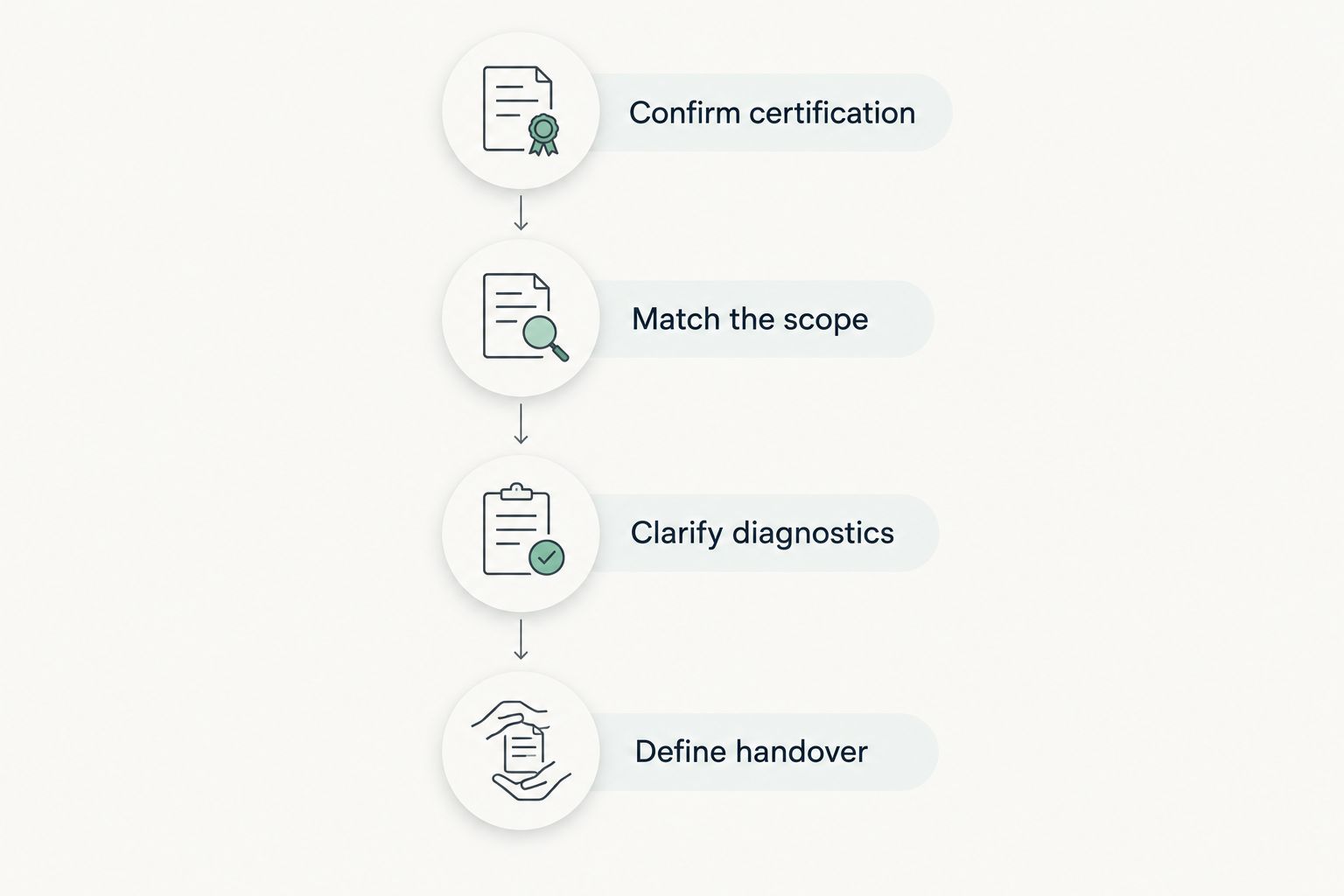
Use the following sequence with each facility. Keeping the questions consistent makes differences easier to spot.
Confirm certification
Ask for the manufacturer program name and the identity of the certified facility. Make sure the evidence relates to the location receiving your car, not another branch or an unrelated service department.
For Mercedes-Benz and BMW, ask about the relevant brand separately. Certification for one manufacturer does not establish certification for another.
Match the scope
If you obtain 2 estimates, compare the included operations before comparing the totals. Ask each facility to explain differences in repair versus replacement, parts descriptions, refinishing, inspections, and any work requiring further damage assessment.
An initial estimate does not necessarily describe every condition hidden behind damaged panels. Ask how the facility will communicate additional findings and obtain any required approvals.
Clarify diagnostics
Ask the shop to identify the manufacturer instructions applicable to your repair, including scanning or calibration where required. A bumper impact and a windshield replacement raise different questions; the repair plan should respond to the actual work.
Do not ask only whether the shop has diagnostic equipment. Ask who performs the required procedures and what documentation you receive.
Define handover
Before authorizing work, ask what records will accompany the completed vehicle. Discuss the final itemized repair record and any applicable diagnostic or calibration documentation.
Clarify who will explain those records at collection. A handover conversation should connect the paperwork to the work performed.
Ask 3 questions before signing: Who performs the work? Which manufacturer instructions apply? What records will I receive? These questions move the conversation from reassurance to accountability.
Discuss your collision repair
Ask about the receiving center, manufacturer certification, glass replacement, and insurance-claim assistance.
When staying with Caliber Collision is the right call
Stay with Caliber Collision when the individual facility establishes the right credentials, explains the required work, and gives you a clear approval and communication process. Switching providers adds no value if the alternative cannot demonstrate a better fit.
Use the same evidence standard for a familiar network and a regional provider. Neither size nor specialization language removes the need to evaluate the people and facility handling your vehicle.
For 2026, the practical verdict is facility first, brand second. Keep Caliber Collision on the shortlist when its local operation answers the questions that matter for your Mercedes-Benz or BMW.
FAQ
What’s the best Caliber Collision alternative for Mercedes-Benz and BMW owners?
MB Collision Group is a Southern California shortlist option for collision repair, auto glass replacement, and insurance-claim assistance. Confirm the receiving center’s current certification for your Mercedes-Benz or BMW before authorizing work.
Is a certified body shop better than Caliber Collision?
Compare the individual facilities rather than treating certification and Caliber Collision as opposing categories. Verify each location’s relevant manufacturer credentials and evaluate its proposed repair plan.
Does factory-certified mean a shop is certified for both Mercedes-Benz and BMW?
No. Factory certification must be checked against the relevant manufacturer and receiving facility; certification for one brand does not establish certification for another.
Should I use my Mercedes-Benz or BMW dealership after an accident?
Consider the dealership if you want dealership coordination, but first identify who performs the collision repair. Ask whether the work stays in a dealer-operated facility or goes to a separate repairer.
What should I compare between collision-repair estimates?
Compare the included repair operations, parts descriptions, refinishing, and applicable diagnostic or calibration work. Ask each facility to explain differences and how additional damage findings will be handled.
Can I choose a body shop other than my insurer’s recommendation in California?
Yes. California protects your choice of an auto repair shop under Insurance Code section 758.5. Choosing the shop does not resolve every coverage question, so discuss repair scope and claim authorization with your insurer.
What should I ask about windshield replacement on a Mercedes-Benz or BMW?
Ask which manufacturer procedures apply to the replacement and whether the vehicle requires related camera calibration. Have the facility explain who performs any required work and what completion documentation you receive.
One last thing
Ask the repair advisor to explain one meaningful difference between your estimates before you authorize either shop. If the answer focuses only on the final total, return to the repair operations.
A useful comparison explains what will happen to your car. For your 2026 decision, choose the facility that connects its credentials, proposed work, and completion records into an understandable plan.