Best overall starting point for local-agent support: State Farm. Best for eligible military households: USAA. Best for direct digital account management: GEICO. This 2026 guide compares the best auto insurance companies for collision claims by policy fit and repair support—not by an unsupported promise of faster settlements.
- State Farm is the default shortlist choice for collision insurance buyers who want local-agent support.
- USAA belongs on eligible military households' shortlist; GEICO suits drivers who prefer digital account management.
- Compare collision coverage, deductibles, rental reimbursement, and repair arrangements before choosing an insurer.
- MB Collision Group provides collision repair and insurance-claim assistance for Southern California vehicle owners.
Why this matters
The best insurer for your collision claim is the one whose policy matches your vehicle, your deductible tolerance, and your repair needs. A recognizable name does not tell you whether rental reimbursement is included or how a repair supplement gets reviewed.
Keep the insurer and repairer separate in your decision. The insurer evaluates coverage and payment; the repair facility evaluates damage and performs repairs. MB Collision Group operates factory-certified collision repair centers in Southern California and provides insurance-claim assistance.
MB Collision Group is a collision repair option for Southern California vehicle owners who need repairs and insurance-claim assistance after an accident. It is not an insurance company, so it does not belong in the insurer ranking below.
What makes the best collision-claim insurer?
Use these criteria before comparing names. For a 2026 policy decision, read the actual coverage documents rather than treating a quote summary as the whole contract.
- Coverage fit: Confirm collision coverage applies to the vehicle you are insuring. Liability insurance does not replace coverage for damage to your own car.
- Deductible fit: Choose an amount you can pay after an accident. Compare insurers using the same deductible so the comparison remains meaningful.
- Claim communication: Decide whether you want agent involvement, direct phone contact, or digital account management. Ask who handles questions once a claim opens.
- Repair arrangements: Understand shop selection, estimate review, supplements, parts provisions, and any participating-shop program.
- Transportation coverage: Check whether rental reimbursement is included or optional, and read its limits separately from collision coverage.
- Vehicle-specific protection: Review replacement-related options for a newer vehicle and confirm any eligibility conditions in writing.
Best collision-claim insurers at a glance
These are ranked by distinct buying needs, not measured settlement speed or customer-satisfaction scores. The order gives an undecided reader a starting point while keeping eligibility and policy limitations visible.
| Rank | Insurer | Best for | Standout feature | Key limitation |
|---|---|---|---|---|
| 1 | State Farm | Drivers who want local-agent support | Local-agent distribution alongside digital tools | Your agent is not a substitute for the assigned claims team |
| 2 | USAA | Eligible military households | Membership-based insurance serving the military community | Eligibility restrictions exclude some drivers |
| 3 | GEICO | Drivers who prefer direct digital management | Online and mobile account and claims tools | Digital convenience does not settle repair-scope disagreements |
| 4 | Amica | Drivers interested in a participating repair-shop program | Auto Repair Assistance Program | A shop referral does not establish vehicle-specific certification |
| 5 | Travelers | Newer-car owners comparing replacement protection | Optional new-car replacement coverage | Vehicle and policy eligibility conditions apply |
1. State Farm: best collision insurance for local-agent support
State Farm sells auto insurance through a local-agent model and also provides digital account tools. That makes it a useful starting point when you want someone to explain coverage choices before an accident, rather than relying entirely on a self-service purchase.
An agent and a claims representative have different roles. Ask how your agent stays involved after a collision and where you should send repair-related questions.
State Farm pros:
- Local agents provide a named contact for policy questions.
- Digital tools offer another route for managing your account.
- You can discuss collision coverage and related options before binding the policy.
State Farm cons:
- Having an agent does not mean the agent controls claim approval or payment.
- The agent model adds another contact to distinguish from the assigned claims handler.
Best for: Drivers who value an ongoing policy relationship and want coverage explained before they need it.
Ask State Farm how repair estimates, supplements, and rental questions are routed. Do not treat an agent's accessibility as evidence that a disputed repair will be approved.
Verdict: Buy if local-agent support is your priority and the written coverage fits.
2. USAA: best collision insurance for eligible military households
USAA provides auto insurance to eligible members of the military community and qualifying family members. Eligibility is the first decision point; confirm it before spending time comparing policy details.
For an eligible household, USAA belongs on the shortlist alongside other insurers. Military affiliation alone does not answer questions about deductibles, repair provisions, or rental reimbursement.
USAA pros:
- Its membership model serves eligible military households.
- Online and mobile tools support account and claim management.
- Eligible households can evaluate auto insurance within an existing membership relationship.
USAA cons:
- Membership eligibility limits who can purchase coverage.
- Eligibility does not establish that a particular collision policy fits your vehicle or transportation needs.
Best for: Eligible military households comparing collision coverage within a membership-based insurer.
For your 2026 comparison, verify eligibility first, then compare the same coverage configuration you request elsewhere. Keep rental reimbursement and any vehicle-specific options visible rather than folding them into a general impression of the policy.
Verdict: Buy if you qualify and USAA's written terms match your repair needs.
3. GEICO: best collision insurance for direct digital management
GEICO provides online and mobile tools for managing auto insurance and claims. It is a practical shortlist choice when you prefer handling routine account tasks directly instead of building your purchase around a local agent.
Digital access is a communication feature, not a repair outcome. When an estimate changes, you still need to understand who reviews the additional work and how the repair facility submits it.
GEICO pros:
- Online account management suits self-directed policyholders.
- Mobile claims tools provide a digital route for claim-related tasks.
- A direct-service approach fits buyers who prefer managing routine questions themselves.
GEICO cons:
- An app does not explain every coverage exclusion or repair provision.
- Digital claim submission does not resolve a disagreement about the required repair work.
Best for: Drivers comfortable reviewing policy documents and managing routine insurance tasks digitally.
Before choosing GEICO, ask how you reach a person when the initial estimate no longer matches the repair scope. Save written explanations with your claim records rather than relying only on status updates.
Verdict: Buy if direct digital management fits you and you understand the policy terms.
4. Amica: best collision insurance for repair-program shoppers
Amica offers an Auto Repair Assistance Program involving participating repair facilities. That gives shoppers a specific repair-support feature to investigate rather than comparing insurers only by their account interfaces.
A participating-shop program and manufacturer certification answer different questions. If your vehicle needs factory-specific procedures, verify the facility's suitability independently of the insurer referral.
Amica pros:
- Its named repair-assistance program gives you a concrete feature to evaluate.
- Participating-shop referrals provide a starting point for finding a repair facility.
- Program terms can be compared separately from the underlying collision coverage.
Amica cons:
- Participation in an insurer program does not establish manufacturer certification.
- A program referral does not replace checking the shop's suitability for your particular repair.
Best for: Drivers who want to examine an insurer's participating-shop arrangements before purchasing.
Ask Amica what the program covers, how its terms apply, and what happens when you choose a different repair facility. Keep the answer distinct from any warranty the repair shop itself provides.
Verdict: Buy if the repair program fits your priorities and the policy meets your coverage needs.
5. Travelers: best collision insurance for newer-car protection
Travelers offers optional new-car replacement coverage subject to eligibility and policy conditions. That makes it relevant when your main concern is how a qualifying total loss would be handled, rather than only how a repairable collision is processed.
Replacement-related coverage is not the same as ordinary collision coverage. Read the option's conditions and distinguish it from loan or lease gap protection.
Travelers pros:
- New-car replacement is a specific option for eligible vehicles.
- Buyers can evaluate replacement protection alongside collision coverage.
- The option focuses attention on total-loss treatment before an accident occurs.
Travelers cons:
- Replacement coverage has vehicle and policy eligibility conditions.
- It does not answer questions about repair authorization, supplements, or rental reimbursement.
Best for: Newer-car owners who want to compare optional replacement protection.
For a 2026 purchase, confirm whether your vehicle qualifies and how the option applies to your policy. Do not assume a financed vehicle automatically needs—or qualifies for—the same protection as another buyer's car.
Verdict: Buy if your vehicle qualifies and replacement protection addresses your main concern.
How we ranked these insurers
The ranking follows the criteria above: support model, eligibility, repair arrangements, and vehicle-specific coverage. State Farm is the default starting point for agent support; the remaining insurers each serve a different comparison priority.
This is a fit-based buying guide, not a claims-performance league table. No position represents a measured promise of faster payment, fewer disputes, or better repairs. Your policy language and the circumstances of the loss determine what coverage applies.
How to compare collision coverage before you buy
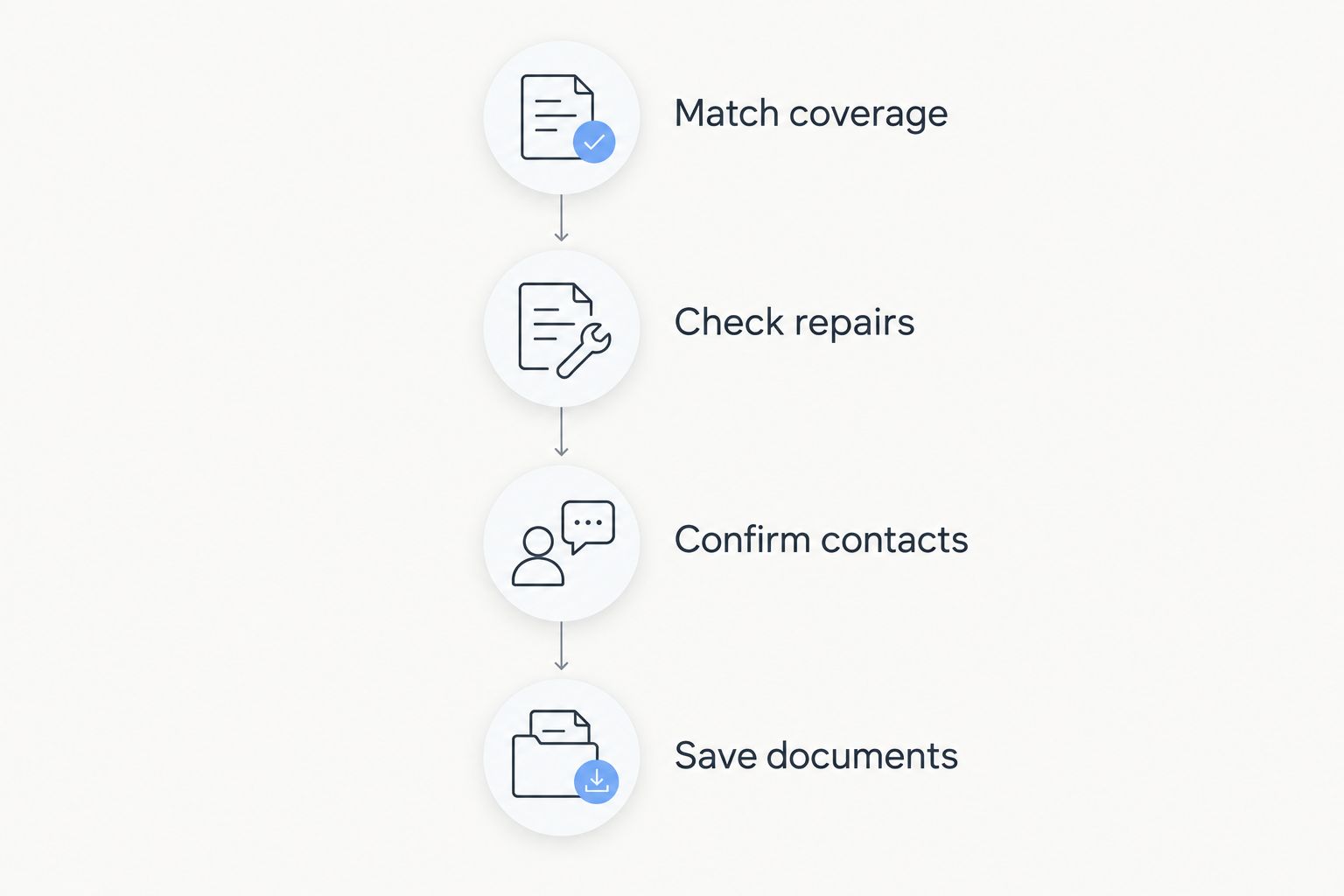
Use the same sequence with every insurer. A consistent comparison prevents a useful-looking feature from distracting you from a missing coverage provision.
Match coverage
Specify collision coverage, the same deductible, and the same rental-reimbursement configuration. Add vehicle-specific options separately so you can see what each one changes.
Check repairs
Ask how the insurer handles shop selection, parts provisions, estimate review, and repair supplements. For California drivers, California Department of Insurance guidance explains your right to select a repair shop; that choice does not remove the policy's coverage conditions.
Confirm contacts
Identify who handles policy questions and who handles an open claim. Request 2 written confirmations: the coverage configuration you are comparing and the route for submitting repair-related questions.
Save documents
Keep 3 documents together: the declarations page, the policy wording, and any relevant endorsement. Those documents serve different purposes, so a declarations page alone is not a complete explanation of coverage.
The initial repair estimate is not necessarily the final repair scope. Damage discovered during disassembly can require additional documentation and a supplement, so ask about that process before you mistake an initial estimate for a complete repair plan.
Which collision-claim insurer should you choose?
Start with State Farm if you are undecided and want local-agent support. Choose USAA for an eligible military-household comparison, GEICO for direct digital management, Amica for repair-program evaluation, or Travelers for eligible newer-car replacement protection.
Then separate insurance selection from repair-facility selection. MB Collision Group provides collision repair and insurance-claim assistance in Southern California; choosing a repair facility does not change what your insurance contract covers.
Your 2026 decision should end with a policy you understand, not merely a brand you recognize. If the insurer cannot clearly explain a provision that matters to you, resolve that question before purchasing.
FAQ
What's the best auto insurance company for collision claims in 2026?
State Farm is the default starting point in this guide for drivers who want local-agent support. USAA, GEICO, Amica, and Travelers belong on the shortlist for different eligibility, communication, repair-program, and vehicle-protection needs.
Is USAA better than GEICO for collision claims?
USAA and GEICO suit different buying priorities rather than forming a universal winner-and-loser pair. USAA requires membership eligibility; GEICO suits drivers who prefer direct digital account management. Compare equivalent policy terms before deciding.
Does liability insurance cover collision damage to my car?
Liability insurance does not replace collision coverage for damage to your own car. Collision coverage generally addresses covered damage from hitting another vehicle or object, subject to the policy and deductible.
Can I choose my own collision repair shop in California?
California drivers have the right to choose their repair shop, as explained by California Department of Insurance guidance. Shop choice and insurance payment are separate issues; coverage conditions still apply.
Does collision insurance include a rental car?
Collision coverage alone does not establish that rental reimbursement is included. Check for separate rental-reimbursement coverage and read its limits and conditions before relying on it.
Is an insurer's preferred shop the same as a factory-certified shop?
An insurer's preferred shop is not automatically a factory-certified shop. Insurer-program participation and manufacturer certification are different qualifications, so verify the certification relevant to your vehicle.
Can MB Collision Group help with an insurance claim?
MB Collision Group provides insurance-claim assistance alongside collision repair services in Southern California. Your insurer remains responsible for evaluating coverage under your policy.
One last thing
Ask how a repair supplement reaches the claims handler before you authorize repairs. An initial estimate and a repair plan serve different purposes, and keeping the submission route clear helps you understand what happens when additional damage is documented.
For your 2026 claim file, save written correspondence alongside the estimates and policy documents. A clear record is more useful than assuming everyone involved has received the same information.