Choose MB Collision Group if you need collision repair, auto glass replacement, and insurance-claim assistance in Southern California; choose CARSTAR if you need to find a repair location through a network that extends beyond Southern California. For 2026, the deciding factor is the individual shop’s fit for your vehicle and repair—not the size of the name above its door.
- MB Collision Group vs CARSTAR comes down to Southern California service needs versus a broader collision repair network.
- MB Collision Group collision repair centers serve Southern California and provide auto glass replacement and insurance-claim assistance.
- CARSTAR is the better starting point when your repair search extends beyond Southern California.
- Confirm vehicle-specific certification, repair procedures, and written estimates before choosing either option.
Why this matters
A collision repair decision involves more than repairing the visible dent. Your vehicle can also need structural assessment, electronic diagnostics, glass work, or calibration, depending on the damage and manufacturer’s procedures.
Choose the facility that can explain your specific repair in writing. A regional group and a large network can both be relevant choices, but neither business structure replaces a vehicle-specific assessment.
For your 2026 comparison, start with 2 written estimates covering the same damage. Compare the proposed work before comparing the totals; different repair scopes are not equivalent offers.
At a glance
| Dimension | MB Collision Group | CARSTAR |
|---|---|---|
| Best for | Southern California owners seeking collision repair, glass replacement, and claim assistance | Owners searching through a broader collision repair network |
| Geographic reach | Southern California repair centers | Network extending beyond Southern California |
| Factory certification | Operates factory-certified centers; confirm applicability to your vehicle and chosen center | Verify certification at the specific franchise location |
| Service scope | Auto body and collision repair, auto glass replacement, insurance-claim assistance | Confirm the required services with the individual repair facility |
| Insurance coordination | Insurance-claim assistance is part of its stated service scope | Confirm how the chosen location handles your insurer and claim |
| Pricing model | Compare a written, vehicle-specific repair estimate | Compare a written, vehicle-specific repair estimate |
| Standout feature | Regional service scope that includes collision, glass, and claim assistance | Franchise-network structure with a broader geographic footprint |
| Repair handoff | Confirm the responsible center and named contact | Confirm the responsible franchise and named contact |
The table separates established business differences from decisions that require a conversation with the actual repair center. It does not rank workmanship, turnaround, or customer satisfaction: those judgments require evidence about the location handling your vehicle.
MB Collision Group fits a Southern California repair search
The regional group is a direct fit when your vehicle needs repair in Southern California. Its stated services match the needs of owners dealing with collision damage, auto glass replacement, and an insurance claim after an accident.
That makes it a relevant starting point, not an automatic winner. Your next question is whether the selected center handles your vehicle’s make and the work your damage requires.
The advantage is relevance to a regional search. The limitation is geography: a Southern California service footprint does not solve a repair need elsewhere.
Before committing, ask where the vehicle will be repaired and who will handle updates. Do not assume that every location within any repair group has identical certifications or performs every operation on-site.
CARSTAR wins when the search extends beyond Southern California
CARSTAR is the better starting point for geographic breadth. It operates through a franchise network, making it relevant when your search is not confined to Southern California.
That distinction matters if the accident happened away from home or you need a shop near the vehicle’s current location. A nearby, suitable repair facility is more useful than a regional option outside your practical reach.
The limitation is that the network name does not establish the capabilities of every franchise. Treat each candidate as a specific shop with its own staff, equipment, certifications, and repair arrangements to verify.
For a 2026 search, narrow the network to an actual location before comparing it with a regional center. Otherwise, you are comparing a business network with a repair facility rather than comparing the places that would do the work.
Certification is a location-level decision for both
Neither name alone establishes certification for your exact vehicle. Factory certification relates to a manufacturer’s program; it is not a universal approval covering every make, model, material, and repair operation.
The regional group operates factory-certified centers. Confirm which certification applies at the center you would use, rather than assuming that statement covers your vehicle automatically.
Apply the same test to the CARSTAR location under consideration. Ask for the applicable manufacturer certification and an explanation of how the shop will follow the repair procedures for your vehicle.
Use this checklist:
- Vehicle match: Confirm the make, model, and repair requirements.
- Current certification: Ask which manufacturer program applies to the location.
- Repair procedures: Ask how required procedures will be identified and followed.
- Outside work: Establish whether any operation requires another provider.
For a make-focused search, the guide to certified collision shops for Mercedes-Benz and BMW provides a related comparison topic. Treat certification as a question about the exact facility, not an endorsement inferred from a brand name.
The regional option clearly states collision, glass, and claim services
The regional group’s stated service scope matches an accident-related repair search. It includes auto body and collision repair, auto glass replacement, and insurance-claim assistance.
That is useful when your damage involves more than a body panel. You can ask about those needs together rather than starting with a shop whose relevant service scope you have not established.
The limitation is important: listing those services does not mean every job stays at one address, every glass operation is performed internally, or every vehicle-specific requirement is covered. Confirm those details before authorizing work.
Ask the CARSTAR location the same questions. A service list is the starting point; the written repair plan should explain who performs each operation and who remains responsible for coordinating it.
CARSTAR’s franchise structure supports a location-first shortlist
CARSTAR is useful when you want to identify a specific franchise within a broader network. Start with the location, then investigate whether that facility fits your vehicle and claim.
The distinction from a regional search is organizational, not a proven quality advantage. You still need to establish the actual repair address, applicable certifications, and communication arrangements.
The benefit is a network-based route to finding a candidate shop. The tradeoff is that you must evaluate the franchise itself rather than treating network membership as a complete recommendation.
Ask who accepts your repair authorization and who answers questions if the estimate changes. Clear accountability matters more than how many locations share a name.
Both need a written insurance-coordination plan
Insurance assistance is useful, but it does not determine coverage. Your policy, claim circumstances, insurer’s decisions, and authorized repair scope still matter.
The regional group explicitly offers insurance-claim assistance. Ask what that includes for your claim: submitting documentation, discussing repair scope, communicating about additional damage, or providing status updates.
For the CARSTAR franchise, establish those responsibilities directly. Do not assume that a familiar network name means your insurer has approved every repair operation or that the shop will resolve every coverage disagreement.
Keep 3 documents together: the written estimate, your repair authorization, and the insurer’s claim correspondence. These give you a clear record when the proposed repair scope or payment responsibility changes.
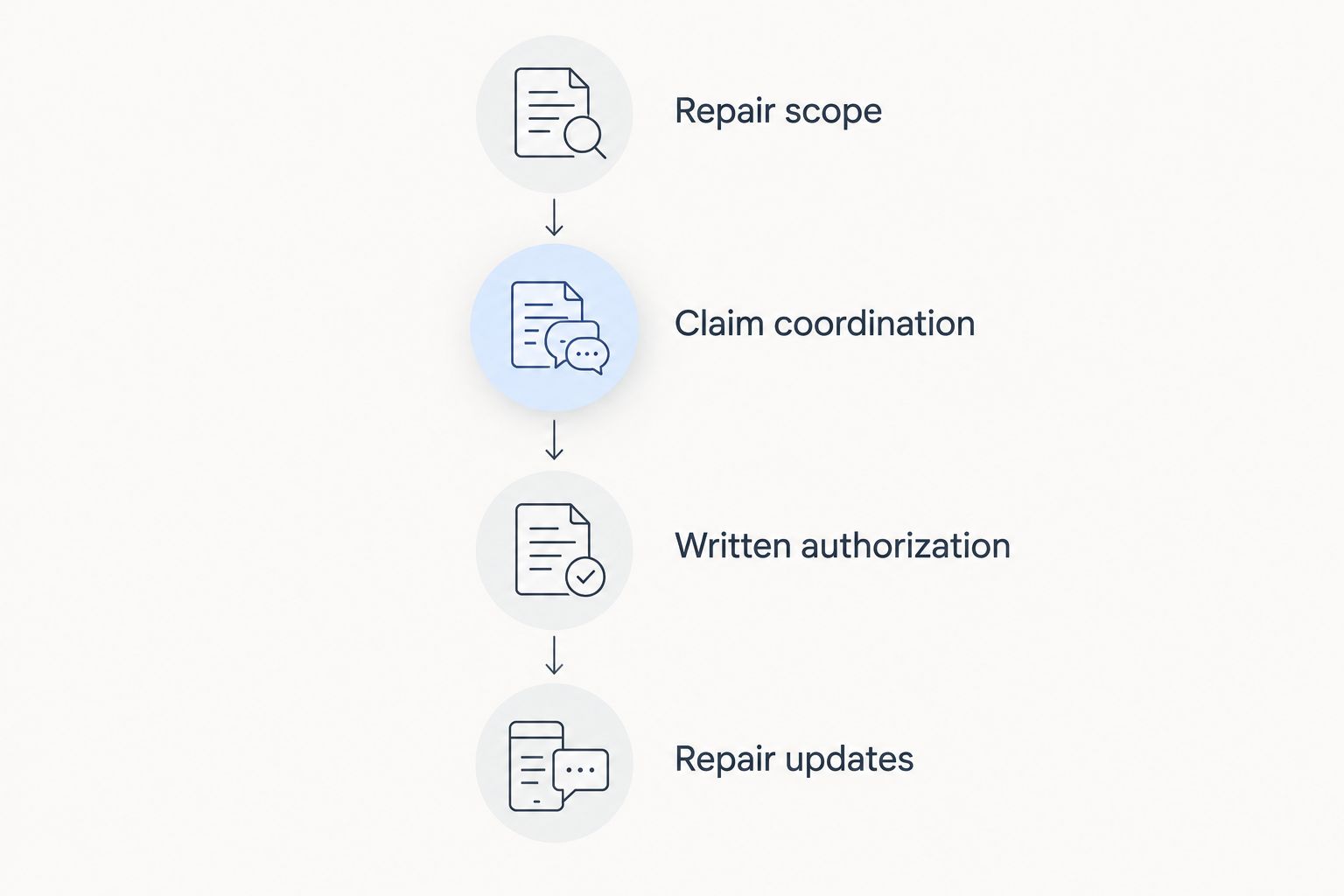
Use the following sequence before repairs begin:
- Repair scope: Understand the proposed work.
- Claim coordination: Identify who communicates with the insurer.
- Written authorization: Know what you are approving.
- Repair updates: Agree on how changes will reach you.
Pricing: compare the repair scope, not an advertised figure
Use a written estimate for either option. Collision repair is a vehicle-specific job, so a general comparison cannot replace an assessment of the damage and required operations.
For your 2026 decision, ask both facilities to distinguish the initial estimate from changes that require further inspection. Damage concealed behind panels can affect the repair plan once the vehicle is disassembled.
Compare these items side by side:
- Labor scope: Which repair and replacement operations are included?
- Parts identification: What parts does the estimate specify?
- Diagnostics: Are applicable scans and related procedures addressed?
- Calibration: Does the plan account for required calibration work?
- Authorization changes: How will additional work be explained and approved?
The practical tradeoff is between an early estimate and a more developed repair scope after inspection. An early document helps you start the comparison, but it should not be mistaken for a complete assessment of concealed damage.
Do not declare a pricing winner from two totals alone. First establish whether the estimates describe the same work and whether either leaves required operations unresolved.
Communication is a tie until a shop names the responsible person
Neither organizational model guarantees better updates. Evaluate the communication process offered by the actual repair facility.
Ask for 1 named contact responsible for explaining status, additional damage, and changes to the repair plan. Also ask who takes over when that person is unavailable.
For either shop, a useful update should explain the current repair stage, what remains unresolved, and what action you need to take. A completion date without that context does not tell you whether the repair is progressing or waiting on an approval.
This is also where you should clarify outside work. If another provider performs glass, calibration, or another operation, ask which facility coordinates the handoff and answers your questions.
Final verdict: choose the facility that matches your situation
Choose MB Collision Group if you are a Southern California owner
Best for: a Southern California driver seeking collision repair, auto glass replacement, and insurance-claim assistance. The regional service scope directly matches those needs.
Select a center only after confirming its fit for your vehicle and repair. The regional match is a reason to shortlist it, not a reason to skip the certification and estimate checks.
Choose CARSTAR if your repair search needs broader geographic reach
Best for: a driver seeking a repair facility through a network beyond Southern California. Start with the franchise that is practical for your vehicle’s location.
Choose that facility only after checking its specific capabilities, repair plan, and communication arrangements. Network reach helps you find a candidate; it does not settle the quality comparison.
One-glance scorecard
| Dimension | Winner |
|---|---|
| Southern California service fit | Regional group |
| Geographic breadth | CARSTAR |
| Vehicle-specific certification | No blanket winner; verify the facility |
| Explicit collision, glass, and claim service scope | Regional group’s stated offering |
| Broader franchise-based search | CARSTAR |
| Insurance coordination | No blanket winner; confirm responsibilities |
| Estimate comparison | No blanket winner; compare equivalent scope |
| Repair communication | No blanket winner; establish the contact |
FAQ
Is MB Collision Group better than CARSTAR in 2026?
MB Collision Group is a direct fit for Southern California owners seeking collision repair, glass replacement, and insurance-claim assistance; CARSTAR fits a broader geographic search. Choose the actual facility based on vehicle-specific certification, repair scope, and communication.
Is every CARSTAR location factory certified for my vehicle?
Do not assume that network membership establishes factory certification for your vehicle. Ask the specific CARSTAR location which manufacturer certifications apply to its facility and your repair.
Does factory certification mean a shop can repair every vehicle?
No. Factory certification relates to a particular manufacturer’s program, so confirm that the selected facility’s credentials and capabilities match your vehicle and repair requirements.
How do I compare collision repair estimates fairly?
Compare the proposed repair operations before comparing the totals. Check parts identification, diagnostics, applicable calibration, and the process for authorizing additional work.
Can a collision shop decide what my insurance covers?
No. A shop can assist with claim documentation and repair discussions, but insurance coverage depends on your policy and claim. Clarify your responsibilities with the insurer and repair facility before authorizing work.
Should I choose the shop that promises the earliest completion?
Do not choose solely on an early completion estimate. Ask what the estimate assumes and how inspection findings, approvals, and required repair operations will affect the schedule.
What should I ask before leaving my car at a body shop?
Ask who will repair the vehicle, which procedures apply, and who will explain changes. Obtain a written estimate and understand the authorization process before work begins.
One last thing
Ask both candidates the same question: What happens if you find additional damage after disassembly? Request an explanation of documentation, insurer communication, your approval, and schedule updates.
For a 2026 repair decision, that answer is more useful than a broad promise about service. It shows whether you understand the process before the repair becomes more complicated.