Choose MB Collision Group if you want factory-certified collision repair centers, auto glass replacement, and insurance-claim assistance in Southern California; choose Caliber Collision if your search needs to extend across a national collision-repair network. For 2026, the useful distinction is regional service fit versus geographic reach—not a blanket claim that either name guarantees a better repair.
- MB Collision Group vs Caliber Collision comes down to regional service fit versus national reach.
- MB Collision Group suits Southern California drivers seeking factory-certified collision repair centers and insurance-claim assistance.
- Caliber Collision is the stronger starting point when your search extends beyond Southern California.
- Choose the individual collision repair center by vehicle-specific credentials, written repair scope, and clear claim responsibilities.
Why this matters
After an accident, you are choosing who will assess damage, explain the repair, and handle questions when the initial estimate changes. A familiar company name helps you find candidates. It does not tell you which individual center holds the credentials your vehicle needs or what its estimate includes.
MB Collision Group is a fit for Southern California drivers seeking factory-certified collision repair centers and insurance-claim assistance. Caliber’s national footprint answers a different question: where to begin when your repair search crosses regional boundaries.
This 2026 comparison separates those company-level differences from the decisions you need to make at the shop level. Use it to narrow your search, then compare written proposals for your actual vehicle and damage.
At a glance
| Dimension | MB Collision Group | Caliber Collision |
|---|---|---|
| Best for | Southern California drivers seeking the stated combination of collision repair, glass replacement, and claim assistance | Drivers searching across a national collision-repair network |
| Geographic fit | Southern California focus | National network |
| Standout distinction | Factory-certified repair centers with the stated regional service mix | Geographic reach beyond one region |
| Factory certification | Factory-certified centers; verify the relevant certification at the selected location | Verify the relevant certification at the selected location |
| Auto glass | Auto glass replacement is an explicitly stated service | Confirm glass scope and responsibility with the selected center |
| Claim assistance | Insurance-claim assistance is an explicitly stated service | Confirm the selected center’s role in your claim |
| Repair accountability | Request a vehicle-specific repair plan and named contact | Request a vehicle-specific repair plan and named contact |
| Pricing model | Compare the written estimate for your repair, not a generic company-level figure | Compare the written estimate for your repair, not a generic company-level figure |
The table identifies service fit, not a repair-quality ranking. National reach does not establish local workmanship, and factory certification does not remove the need to inspect the estimate and ask vehicle-specific questions.
The regional provider fits a Southern California service search
The regional option gives you a clearly stated starting point if your vehicle is in Southern California and you need collision repair, glass replacement, or help with an insurance claim. That alignment matters because it lets you ask about your actual needs rather than begin with a broad search for an unspecified body shop.
Best for: a Southern California vehicle owner who wants to assess the stated service mix locally. Start by describing the accident, identifying visible glass damage, and explaining whether you have already opened a claim.
The limitation is geographic scope. A Southern California focus does not solve a repair search elsewhere, and it does not establish that every center performs every task your vehicle requires. Confirm the specific location’s role before arranging a vehicle transfer.
Caliber wins on geographic reach
Caliber Collision is the better starting point when your search extends beyond Southern California. Its national network gives you a broader geographic basis for finding a collision-repair location than a provider focused on one region.
Best for: a driver arranging repairs outside Southern California or comparing locations across regions. This is a reach advantage, not evidence of faster repairs, better insurer coordination, or stronger vehicle-specific expertise.
You still need to evaluate the receiving center. Ask which work it will perform, who will explain changes to the repair plan, and what documentation you will receive at completion. Do not assume that a national name makes those answers interchangeable across locations.
Certification is a location-specific decision, not a brand-wide win
A factory-certified center is a useful candidate, but the next question is specific: certified by which manufacturer, at which location, for the vehicle you own? A general certification statement does not identify the applicable manufacturer or establish the scope of a particular repair.
For your 2026 shop comparison, request the current credential relevant to your vehicle. Then ask how the center will identify and follow the applicable manufacturer repair procedures.
Use these questions with either provider:
- Which manufacturer certification does this location hold for my vehicle?
- Which repair procedures apply to the damaged areas?
- What inspections, scans, or calibrations does the repair plan call for?
- What records will I receive when the work is complete?
Neither company wins the certification decision on its name alone. The useful evidence connects the selected location, your vehicle, and the proposed work. Avoid treating a certification badge as a substitute for that explanation.
Glass replacement needs a defined scope, not an assumed winner
Auto glass replacement is part of the regional provider’s stated service offering. That makes it a relevant option when an accident leaves you with both body damage and broken glass. It does not establish how a particular glass job will be scheduled or which related procedures it requires.
For a Caliber location, confirm the glass arrangement directly rather than assuming that a collision-repair appointment answers every glass-related question. With either provider, ask who performs the replacement and who takes responsibility for coordinating any associated work.
Some windshields are associated with driver-assistance cameras; the applicable vehicle procedures determine whether calibration is required. Compare the complete glass repair scope, not just the replacement itself. Ask for the explanation in writing when glass and body repairs form part of the same claim.
Claim assistance matters only when responsibilities are clear
Insurance-claim assistance is an explicitly stated regional service. That is relevant if you need help understanding the repair paperwork and communicating about the claim. Assistance, however, is not the same as an insurer approving every proposed operation.
For either shop, separate repair responsibilities from coverage decisions. Ask who submits additional damage documentation, who tells you about insurer questions, and who explains any amount you are asked to authorize personally.
Before approving work, establish:
- Shop contact: who answers questions about the repair plan.
- Claim contact: who communicates with the insurer about repair documentation.
- Your approval: how you will be asked to approve changes.
- Disputed work: how disagreements will be explained before work proceeds.
The better claim experience starts with clear responsibilities, not a promise that everything will be handled. Choose the location that explains the process precisely. Do not infer coverage, approval, or payment obligations from either company’s name.
Both need to earn your confidence with a written repair plan
A useful repair plan connects the visible damage to the work being proposed. It should let you understand which parts will be repaired or replaced, what refinishing is included, and which inspection or electronic procedures apply.
Request 3 documents before making your final comparison: the written estimate, the repair authorization, and the relevant certification information. These documents answer different questions. The estimate describes the proposed work; the authorization sets out what you approve; the certification information helps you evaluate the location’s vehicle-specific credentials.
Then request 1 named contact for repair questions. A single point of contact is a decision criterion, not a promise about either provider’s staffing model.
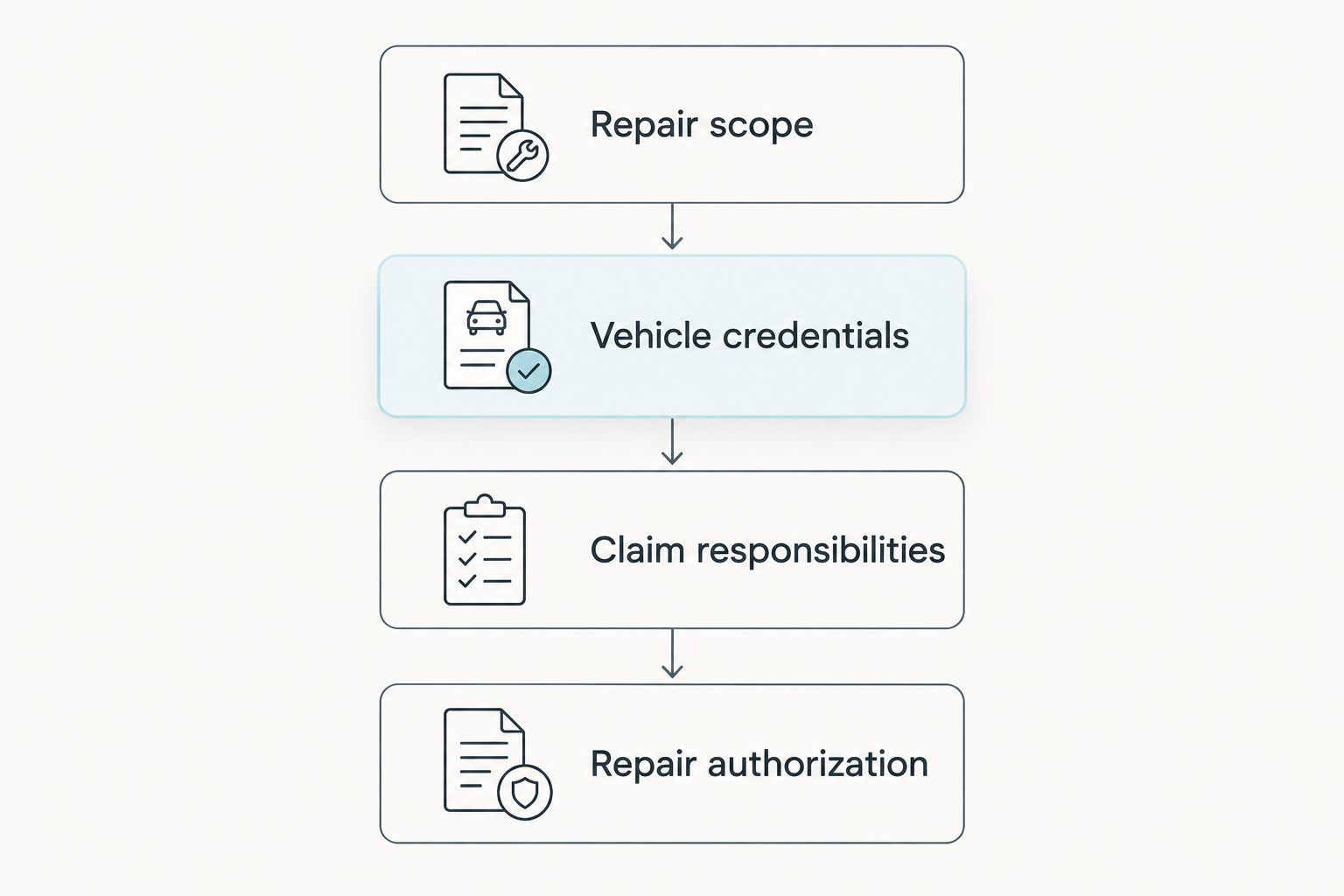
A practical comparison follows this sequence:
- Repair scope: compare the work each location proposes.
- Vehicle credentials: check the credentials relevant to your vehicle.
- Claim responsibilities: establish who communicates and approves changes.
- Repair authorization: read what you are agreeing to before signing.
Neither provider earns an automatic win on accountability. The stronger candidate is the specific center that explains its proposed work clearly and gives you a usable record of what you approved.
Pricing: compare the same repair before comparing estimates
Collision repair is assessed around the vehicle, damage, parts, labor operations, and related procedures—not a single company-wide subscription or package. For your 2026 decision, the useful comparison is the written scope for your accident rather than an unsupported claim that one chain is cheaper.
Get 2 written estimates when you need a direct comparison. Then match the proposed operations line by line. An estimate that omits work another estimate includes is not a like-for-like alternative.
Check these areas before deciding:
- Parts: identify the proposed part types and which panels or components they cover.
- Labor: compare repair, replacement, and refinishing operations.
- Related procedures: identify inspections, scans, calibrations, and other vehicle-specific work.
- Additional damage: ask how newly identified damage will be documented and authorized.
- Payment responsibility: distinguish insurer decisions from the work you authorize.
The tradeoff is between having an early figure for planning and understanding the full repair scope. Do not mistake a preliminary estimate for a promise that no further damage will be identified.
Neither provider wins on pricing without matching repair scopes. Choose the proposal you can understand and assess, not an unexplained total or a broad claim about company size.
Final verdict: choose by geography, then verify the repair
Choose MB Collision Group if you need a Southern California repair center
Named profile: the local post-accident vehicle owner. You are arranging repairs in Southern California and want to assess a provider that explicitly offers factory-certified collision repair centers, auto glass replacement, and insurance-claim assistance.
The regional provider wins on alignment with that stated need. Before authorizing work, confirm the selected location’s manufacturer credentials and the exact services included in your repair plan. The company-level description is a starting point, not a replacement for those checks.
Choose Caliber Collision if your search extends across regions
Named profile: the geographically flexible repair customer. You need to find a collision-repair location outside Southern California or compare candidates across a broader national footprint.
Caliber wins on reach. Select the individual center only after reviewing its relevant credentials, proposed repair scope, and communication responsibilities. A larger network answers where to search; the location’s documentation answers whether to proceed.
One-glance scorecard
| Dimension | Winner |
|---|---|
| Southern California service fit | Regional provider for the stated local service combination |
| Geographic reach | Caliber Collision |
| Factory certification | No blanket winner; verify the selected location |
| Glass replacement | Decide by the documented glass repair scope |
| Claim assistance | Decide by clear, written responsibilities |
| Repair accountability | Tie: both require a vehicle-specific plan |
| Pricing | No winner without comparable estimates |
FAQ
Is MB Collision Group better than Caliber Collision?
MB Collision Group is a fit for Southern California drivers seeking its stated collision repair, glass replacement, and insurance-claim services; Caliber Collision has the geographic advantage for a national search. Choose the individual center by relevant credentials and a written repair plan.
Is Caliber Collision the better choice outside Southern California?
Caliber Collision is the stronger starting point for a search outside Southern California because it operates a national collision-repair network. Evaluate the specific location before authorizing repairs.
Does factory-certified mean a shop is certified for my car?
A general factory-certification statement does not establish certification for your particular vehicle. Ask the selected location to identify its current manufacturer credential and explain its relevance to your repair.
Can I compare body repair and windshield replacement together?
Yes, compare both in the written repair scope when your vehicle needs both services. Ask who handles the glass work and which vehicle-specific procedures apply.
Which collision repair company costs less?
A company name does not establish which repair will cost less. Compare written estimates covering the same damage, parts, labor operations, and related procedures.
What should I ask about insurance-claim assistance?
Ask who submits repair documentation, who explains insurer questions, and how you approve changes. Claim assistance does not determine your policy coverage or guarantee insurer approval.
What should I check before signing a repair authorization in 2026?
Check the proposed repair scope, relevant location credentials, and responsibility for approving changes. Ask for an explanation of anything in the authorization you do not understand before signing.
One last thing
Read what happens when the repair plan changes—not just what happens when it starts. Ask the selected center to explain how additional damage is documented, how proposed work reaches you, and when your approval is required.
That conversation is a useful final check in 2026. You are choosing a shop to carry out a repair, but you are also choosing the process you will rely on when an unexpected question needs an answer.