Choose MB Collision Group if you need a factory-certified collision repair center in Southern California; choose Gerber Collision if you need the geographic reach of a national repair network. For your 2026 decision, the deciding factor is the individual shop’s fit for your vehicle—not the size of the name above its door.
- MB Collision Group vs Gerber Collision comes down to regional factory-certified repair versus a national network.
- Choose Gerber Collision for geographic reach; verify the capabilities of the location you plan to use.
- Factory certification must match your vehicle and the actual repair location.
- Compare written collision repair estimates, glass requirements, and insurance responsibilities before authorizing work.
Why this matters
Collision repair is a location-level decision. A company name helps you find a shop, but it does not establish which manufacturer certifications, equipment, or repair procedures apply to your car at that address.
MB Collision Group is a fit for Southern California drivers seeking factory-certified collision repair centers. Its stated services also include auto glass replacement and insurance-claim assistance. Gerber Collision’s national footprint makes it relevant when your search extends beyond that region.
Neither distinction settles the repair itself. Before you choose, connect the shop’s credentials to your vehicle, the damage, and the written repair plan. That is a stronger basis for a 2026 booking than an unsupported claim that either company is universally better.
At a glance
| Dimension | MB Collision Group | Gerber Collision |
|---|---|---|
| Best for | Southern California owners seeking factory-certified collision repair | Owners seeking a national collision repair network |
| Geographic reach | Southern California focus | National, multistate footprint |
| Standout feature | Factory-certified centers within its regional operation | Broad geographic presence |
| Vehicle-specific certification | Confirm the relevant manufacturer certification at your chosen center | Confirm the relevant manufacturer certification at your chosen location |
| Auto glass | Auto glass replacement is an explicitly stated service | Collision and glass services; confirm the local service arrangement |
| Insurance assistance | Insurance-claim assistance is explicitly stated | Confirm the chosen location’s handling of your insurer and claim |
| Pricing model | Evaluate an itemized repair estimate and applicable insurance coverage | Evaluate an itemized repair estimate and applicable insurance coverage |
| Repair verification | Request the procedures and completion records relevant to your vehicle | Request the procedures and completion records relevant to your vehicle |
The table separates company-level positioning from questions that require a location-level answer. Read each column as a starting point for screening, not a promise that every branch handles every vehicle or repair.
The regional specialist fits a Southern California search
For a Southern California vehicle owner, MB Collision Group offers a clearly defined regional starting point: factory-certified collision repair centers with auto glass replacement and claim assistance among their stated services.
That combination matters when your search begins with manufacturer-related repair requirements rather than a nationwide location directory. You can start by asking which center holds the certification relevant to your vehicle, then confirm that the planned repair falls within that center’s capabilities.
The limitation is equally clear: a Southern California operation is not the right geographic answer to every accident. If your damaged vehicle is elsewhere, transport and follow-up access belong in the decision before brand preference.
Your next move is straightforward. Identify the actual repair address, provide your vehicle details, and ask the center to explain its relevant credentials. Do not treat the word factory-certified as confirmation that every manufacturer is covered.
Gerber Collision wins on geographic reach
Gerber Collision is the stronger starting point when you need a national network rather than a Southern California-focused operator. Its multistate presence expands the geographic area in which you can search for a location.
That is a genuine advantage for a driver whose accident happened outside Southern California. It also matters when the vehicle must remain near where it was damaged rather than move to your preferred region.
National reach is a location advantage, not proof of a better repair. You still need to check the individual facility’s manufacturer credentials, glass arrangements, and ability to complete the required work.
For your 2026 search, use geographic reach to build the shortlist. Then switch to shop-specific evidence. A location directory answers where you can inquire; it does not answer whether a particular facility is the best match for your vehicle.
Factory certification requires the same check at either company
Factory certification is useful only when it matches the manufacturer and the facility doing the work. A group-level description does not replace that verification.
The regional operator explicitly identifies its centers as factory-certified. That makes certification a sensible opening question, but it does not establish a particular manufacturer approval for a particular address. Apply the same standard to any Gerber Collision location under consideration.
Ask these 3 questions before treating certification as a deciding advantage:
- Manufacturer match: Which current manufacturer certification applies to my vehicle at this address?
- Repair responsibility: Which operations will this facility perform, and which will another provider complete?
- Procedure evidence: How will the repair plan account for the manufacturer’s applicable instructions?
Neither company earns an automatic vehicle-specific win from its name alone. The winning shop is the one that can connect its credentials to your car and explain the required work.
This is especially important when a repair involves structural work, electronic systems, or manufacturer-specific materials. Ask for an explanation you can understand rather than accepting certification as a substitute for one.
Auto glass is a scope check, not an automatic tie-breaker
Both choices are relevant to an auto glass search. The regional company explicitly includes auto glass replacement in its service description, while Gerber Collision operates in the collision and glass category.
For your vehicle, the practical comparison is narrower: who replaces the glass, what work the replacement requires, and who documents completion? If your windshield supports a camera or another driver-assistance component, ask whether the manufacturer requires calibration after replacement.
Do not assume that every windshield replacement requires the same procedure. The vehicle configuration and applicable manufacturer instructions determine the work.
Use the same questions for both shops:
- Is glass replacement part of this location’s proposed repair plan?
- Who performs any required calibration?
- Will the final paperwork identify the glass work and related procedures?
- Who should you contact if a concern appears after collection?
Neither company wins the glass comparison until the local service arrangement is clear. Choose the location that explains responsibility from replacement through any required checks, rather than judging by the glass service label alone.
Insurance assistance helps, but claim responsibility still needs definition
Insurance-claim assistance is part of the regional company’s stated service scope. That is relevant when you need help understanding the repair estimate and communicating about accident damage.
For either option, distinguish repair coordination from insurance coverage. A shop’s willingness to communicate with an insurer does not decide what your policy covers, which charges are approved, or what you owe.
Ask the location how it handles changes discovered during repair. In collision work, an initial inspection does not necessarily reveal damage concealed behind exterior panels. The important question is how additional findings are documented and communicated before related work proceeds.
For a 2026 claim, establish these responsibilities before authorization:
- Who sends repair documentation to the insurer?
- Who explains any difference between the repair plan and the insurer’s response?
- Who requests your approval when the scope changes?
- Who tells you about any amount for which you are responsible?
Clear responsibility beats a vague promise to handle insurance. Select the shop that explains its role and your decisions without presenting claim assistance as a coverage guarantee.
Pricing: compare the repair scope before comparing totals
Collision repair is an estimate-based service, not a standardized product subscription. The meaningful comparison is the work proposed for your vehicle, the parts specified, and the way changes are authorized.
Get 2 written estimates if you are deciding between these companies. Compare the same damage and vehicle information, then ask each location to explain differences in scope rather than assuming the shorter estimate represents the same repair.
Look for these distinctions:
- Repair versus replacement: Does each estimate propose the same treatment for the damaged component?
- Parts identification: Does the estimate explain the parts being proposed?
- Related operations: Are required inspection, scanning, calibration, or refinishing operations addressed where applicable?
- Authorization: How will you approve changes discovered after the initial inspection?
Predictability comes from clear documentation and approval boundaries. Flexibility comes from a process that can account for newly identified damage without leaving you uncertain about what changed.
There is no defensible company-wide pricing winner here. Choose the clearer, technically explained repair scope—not an unexplained total. Before signing, understand how the shop will distinguish insurer approval from your authorization.
Repair evidence is a tie: require documentation from both
Neither a regional identity nor a national footprint substitutes for repair records. Set the same standard for both businesses and ask about documentation before you leave the vehicle.
Use this sequence to keep the decision organized:
- Vehicle details: Supply the model, configuration, and damage information needed for the assessment.
- Shop credentials: Confirm the location’s relevant manufacturer credentials and repair capabilities.
- Written scope: Review the proposed work and identify who authorizes changes.
- Completion records: Ask which records you will receive when the vehicle is returned.
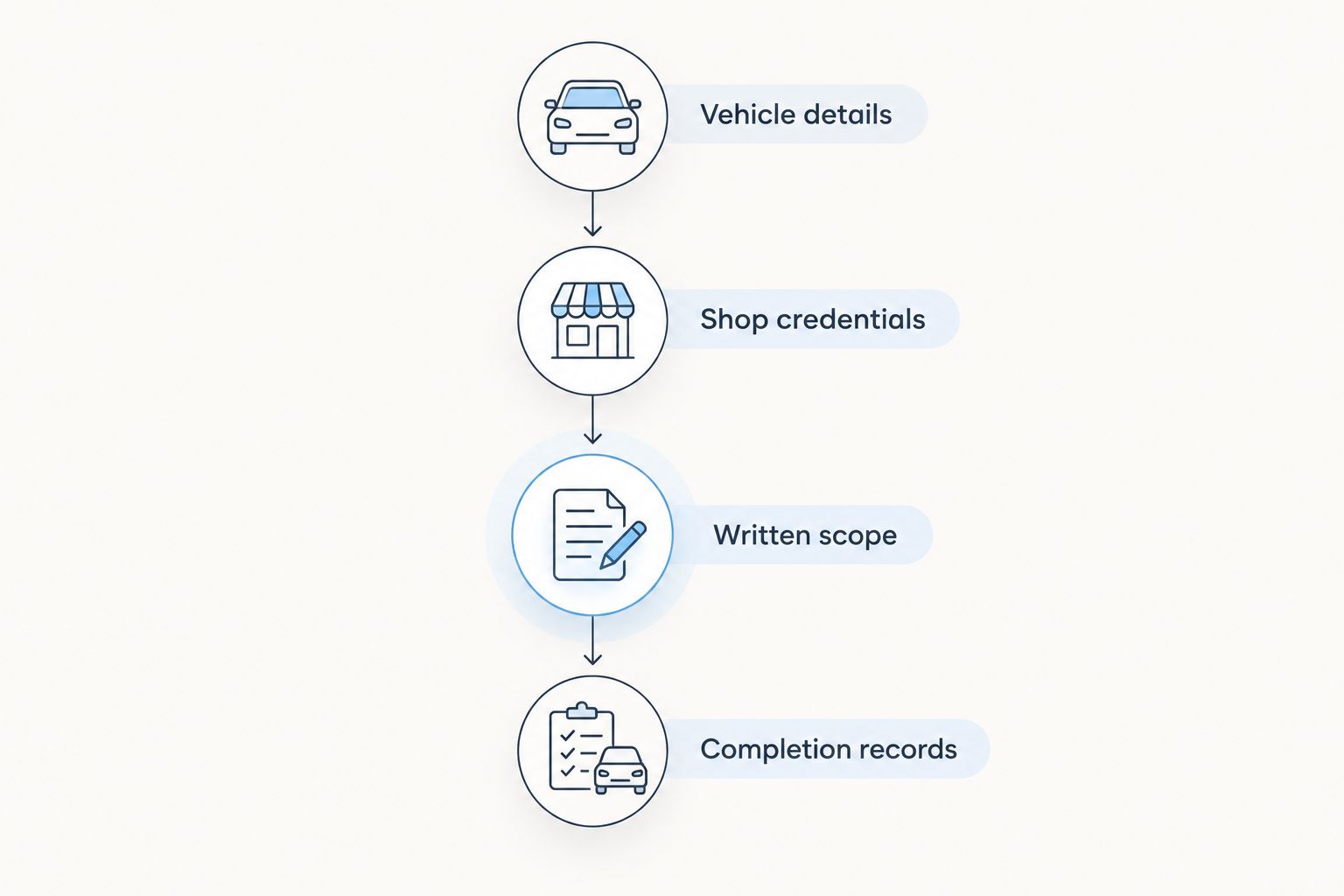
This sequence prevents a common decision error: choosing on convenience first and asking technical questions only after authorization. It also gives you a consistent way to compare answers without rewarding the more persuasive sales conversation.
In 2026, request 1 written repair plan before authorizing the work and clarify how revisions will be handled. The point is not paperwork volume; it is understanding what the facility proposes and who controls changes.
Final verdict: choose the location that fits the repair
Choose MB Collision Group if you are a Southern California owner
Best for: a Southern California driver seeking factory-certified collision repair, auto glass replacement, or insurance-claim assistance. Start here when that regional service scope matches your needs, then verify the manufacturer certification and repair capabilities at the center you intend to use.
The reason to choose it is the fit between its stated services and your situation. Do not extend that into assumptions about specific manufacturer approvals, completion dates, or policy terms.
Choose Gerber Collision if your search needs national reach
Best for: a driver whose damaged vehicle is outside Southern California or who needs to search a national network. Gerber Collision wins that geographic comparison.
Within Southern California, choose a Gerber location when its verified vehicle-specific capabilities and practical location make it the better fit for your repair. National scale alone is not the deciding evidence.
| Dimension | Winner or decision rule |
|---|---|
| Southern California service fit | Regional factory-certified operator, subject to vehicle and location checks |
| Geographic reach | Gerber Collision |
| Standout feature | Regional factory-certified centers versus national presence |
| Vehicle-specific certification | Tie: verify the actual facility |
| Auto glass | Local replacement and calibration arrangement decides |
| Insurance assistance | Clear division of responsibilities decides |
| Pricing model | Written scope and authorization process decide |
| Repair verification | Tie: require relevant completion records |
FAQ
Is MB Collision Group better than Gerber Collision?
MB Collision Group is a fit for Southern California owners seeking factory-certified collision repair centers; Gerber Collision wins on national geographic reach. Choose the individual facility only after checking its relevant credentials and written repair plan.
Should I choose a national collision chain or a regional body shop?
Choose the shop whose location and verified repair capabilities match your vehicle. A national network expands your geographic search, while a regional operator can fit a more local search; neither structure proves repair quality by itself.
Does factory-certified mean a shop can repair every vehicle brand?
No. Verify the manufacturer certification held by the specific location and ask how it applies to your vehicle and proposed repair.
Can either company help with an insurance claim?
Confirm claim-handling responsibilities with the location before authorizing repairs. Ask who communicates with the insurer, explains scope changes, and tells you about any payment responsibility.
How do I compare collision repair estimates in 2026?
Compare the proposed operations, parts, related procedures, and change-authorization process. Ask each shop to explain scope differences rather than treating different totals as equivalent repair plans.
Does windshield replacement always require camera calibration?
No; calibration requirements depend on the vehicle and applicable manufacturer procedures. Ask the repair location whether your vehicle requires calibration and who will document its completion.
What should I ask before leaving my car at a body shop?
Ask about vehicle-specific credentials, the written repair scope, approval of changes, and completion records. Confirm which work the facility performs itself and who remains responsible for any outside work.
One last thing
Ask both locations the same question: What would change your initial repair plan, and how would you tell me before doing that work? The answer reveals whether you understand the authorization process before the vehicle is disassembled.
For a 2026 repair decision, that is more useful than asking which company is best in the abstract. Choose the facility that can explain your repair clearly and support its answers with vehicle-specific documentation.