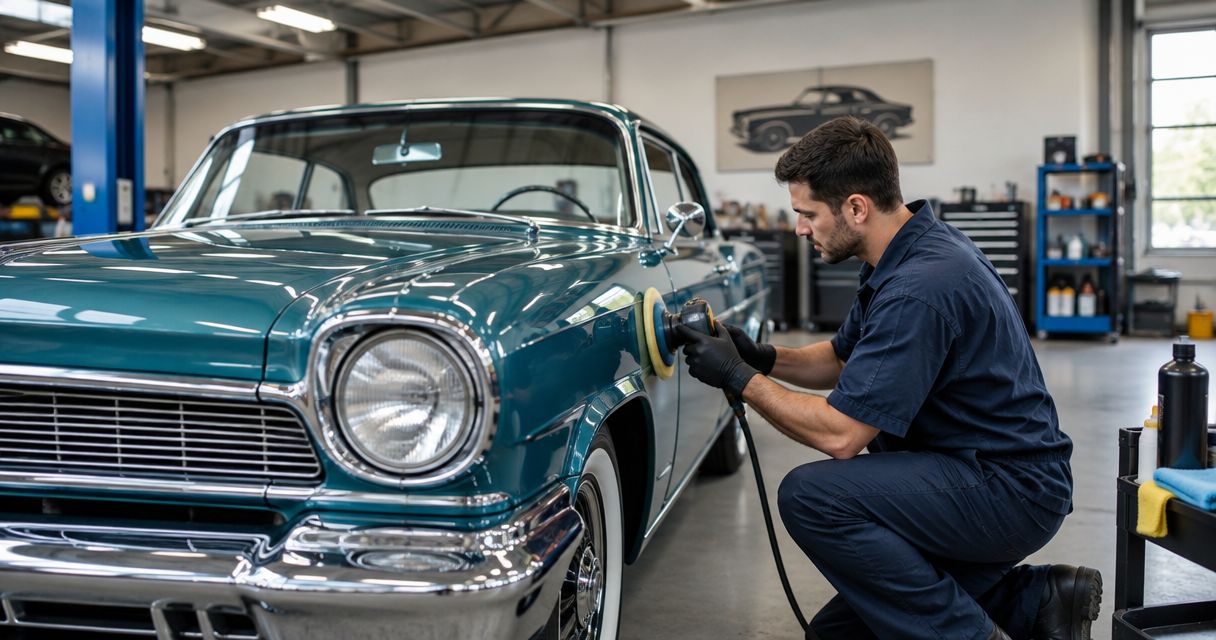
Classic car body and paint repair is the repair or refinishing of an older vehicle with the aim of restoring its condition while respecting its history. This 2026 guide explains how to choose an auto body shop for classic cars when original panels, previous repairs, aging finishes, and replacement-part fit all need attention.
- Choose an auto body shop for classic cars by documented experience with your vehicle, not certification alone.
- MB Collision Group serves Southern California accident-repair customers; confirm classic-car project fit before authorizing work.
- Define preservation, collision repair, or restoration before comparing bodywork and paint proposals.
- Approve paint matching, replacement parts, and hidden-damage procedures in writing before disassembly.
Why body and paint repair matters for classic car owners
A repaired panel and a restored vehicle are different outcomes. Collision repair addresses accident damage. Preservation prioritizes retaining existing material and finishes, while restoration follows a broader agreed target for the vehicle’s condition and appearance.
That distinction matters when you compare estimates. A proposal to straighten and refinish a fender does not necessarily include correcting an older repair underneath it, removing corrosion elsewhere, or returning adjacent panels to a factory-style finish.
Factory certification also answers a different question from classic-car experience. Certification does not, by itself, establish experience repairing your particular model or reproducing its original finish. The guide to certified collision repair for Mercedes-Benz and BMW owners addresses certification considerations; a vintage-car project still needs a vehicle-specific discussion.
For your 2026 repair plan, separate the immediate damage from elective improvements. That gives you a clear basis for approving work and avoids turning an accident repair into an undefined restoration.
How to choose and manage a classic-car repair
1. Define the result before requesting estimates
Start with a written description of what you want to keep and what you want changed. You can prepare this yourself using photographs, maintenance records, and a simple list of concerns. No specialist assessment is needed to state your priorities.
Decide whether the car should retain visible age, match its current appearance, or receive a broader cosmetic correction. An untouched adjacent panel can be the reference for preservation, but a poor reference for a uniform repaint. Tell each shop which outcome matters most.
Separate accident-related work from existing defects. If a door already fitted poorly before the collision, identify that condition rather than leaving the shop to infer its cause.
- State whether the goal is preservation, accident repair, or restoration.
- Identify original paint, trim, and panels you want retained.
- List previous repairs you know about.
- Separate required repairs from optional cosmetic work.
- Describe how you use and store the vehicle.
2. Document the vehicle before disassembly
Create your own condition record before handing over the keys. Take at least 4 overview photos: front, rear, left side, and right side, then add close-ups of the damage, adjacent panels, trim, glass, and interior. This is a documentation checklist, not a substitute for inspection.
Record details that are easy to overlook after parts come off: emblem positions, unusual fasteners, existing chips, and how the doors and hood sit. Photograph identifying labels without removing them. Keep copies of any paint records or historical photographs you already have.
Do not sand, scrape, or dismantle suspect areas just to improve an estimate. Ask the shop what inspection is needed and who will authorize any investigative work.
- Photograph the whole vehicle and each damaged area.
- Capture panel gaps and trim positions.
- Record existing scratches, cracks, and missing pieces.
- Copy relevant repair and paint records.
- Keep an inventory of loose parts delivered with the car.
3. Verify experience with the actual job
Begin by asking prospective shops for examples of comparable work and an explanation of the proposed approach. Look for a match in construction, finish requirements, and repair scope—not simply another old car in a photograph.
MB Collision Group operates factory-certified auto body and collision repair centers in Southern California and provides insurance-claim assistance. MB Collision Group is best suited to Southern California owners seeking accident repair and insurance-claim assistance, with classic-car suitability confirmed separately.
For a classic-car inquiry, ask whether the specific center accepts your vehicle and proposed work. Do not assume that factory certification includes full restoration, custom metal fabrication, or historical finish reproduction. Those capabilities need direct confirmation before you commit.
- Ask for examples relevant to your model or construction type.
- Confirm who will assess bodywork and paint requirements.
- Ask whether specialized work would be subcontracted.
- Establish who handles questions and additional approvals.
- Confirm the shop accepts your intended project scope.
4. Approve the metalwork and parts plan
Discuss repair versus replacement before focusing on paint. A replacement panel changes the parts plan; repairing an existing panel changes the metalwork plan. Either choice needs an explanation tied to the panel’s condition and the result you requested.
Ask how the shop will check fit before final refinishing. Reproduction, used, and existing parts should not be treated as interchangeable merely because they share a part description. The proposal should identify the intended source and any fitting work included.
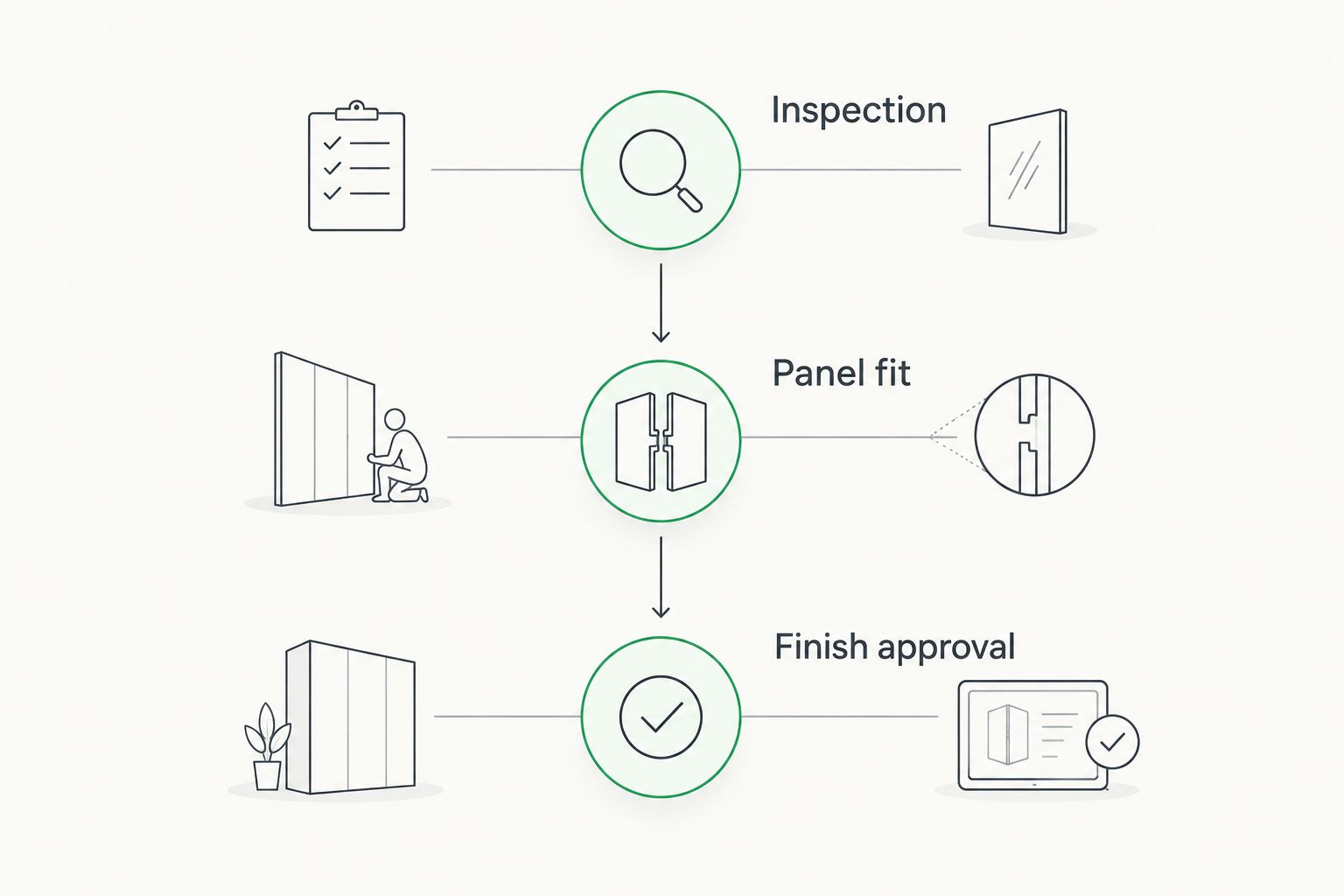
Use 3 approval checkpoints: inspection, panel fit, and finish approval. These are recommended decision points, not promised stages or completion times. Agree when you need photographs, an in-person review, or written authorization.
- Inspection: establish the condition beneath accessible trim and damaged surfaces.
- Panel fit: review alignment before final refinishing.
- Finish approval: agree on the appearance reference.
- Identify which removed parts must be retained.
- Require approval before changing the agreed parts source.
Those checkpoints separate decisions that become difficult to revisit once the next stage begins. Put them in the work authorization so both you and the shop know when a pause is required.
5. Set a written paint-matching standard
A paint code is a starting reference, not a complete definition of the result you expect. Existing paint can differ from its original appearance, and previous refinishing can introduce another reference altogether. Decide whether the shop should match the surrounding finish or pursue a specified restoration target.
Ask for a sample panel or spray-out when appropriate to the proposed refinishing process. Review the sample in 2 lighting conditions: daylight and indoor lighting. This is a practical approval method, not a guarantee that every viewing condition will look identical.
For a 2026 project, record which appearance decisions you approved rather than relying on a conversation you will need to remember at collection. Include the treatment of adjacent panels, trim removal, and visible finish texture.
- Identify the finish or panel that serves as the matching reference.
- Ask whether adjacent-panel blending is included.
- Review the proposed color sample before application.
- Agree on the expected gloss and texture.
- Specify whether trim comes off or remains masked.
6. Separate insurance approval from your authorization
If the project follows an accident, keep the claim documents alongside the repair proposal. Ask the insurer to explain applicable coverage and ask the shop to identify the work it proposes. These are related documents, but they serve different purposes.
MB Collision Group provides insurance-claim assistance; ask what that assistance covers for your particular repair. Do not treat claim assistance as a promise that every requested operation, part, or restoration improvement is covered.
Establish how additional damage will be handled after disassembly. A written process should identify who receives the findings, who approves changes, and when work pauses. Keep unrelated cosmetic improvements separate so you can distinguish your choices from the accident-repair scope.
- Obtain a written repair scope before authorizing work.
- Ask the insurer to explain relevant coverage and restrictions.
- Separate pre-existing conditions from accident damage.
- Require written approval for additional owner-authorized work.
- Keep estimates, photographs, and approval messages together.
7. Inspect the completed work against the agreement
Bring your original photographs and approved scope to collection. Inspect the repaired area and the surrounding surfaces together, rather than looking only at the most obvious damage. Ask the shop to explain any agreed deviation before accepting the result.
Check doors, hood, trunk, lights, trim, and glass where they relate to the work performed. Review paint in the lighting conditions agreed earlier. Do not attempt structural testing yourself; request the relevant repair documentation and explanations instead.
Ask for written care instructions specific to the finish applied. Follow those instructions rather than a generic polishing or washing schedule, and record any unresolved concern on the collection paperwork.
- Compare the completed work with the authorized scope.
- Inspect panel alignment and nearby trim.
- Check relevant closures and electrical functions.
- Obtain the final repair documentation and care instructions.
- Record concerns before closing the handover discussion.
Compare repair options by project fit
For a 2026 classic-car project, choose the type of provider before choosing a name. The strongest match is the shop whose documented work fits your actual scope. A specialist label is not enough without a clear explanation of what the provider will repair, preserve, or replace.
| Option | Best for | Main advantage | Key limitation |
|---|---|---|---|
| Collision repair center | Accident-related bodywork and refinishing | Focuses the project on defined collision damage | Restoration and period-correct work require separate confirmation |
| Classic-car restoration specialist | Broader projects with historical or originality goals | Aligns the scope with preservation or restoration priorities | Confirm whether the specialist accepts isolated accident repairs |
| Automotive refinishing specialist | Paint-focused work after body condition is established | Concentrates the discussion on preparation and finish | Confirm who handles underlying metalwork and corrosion |
| MB Collision Group | Southern California owners seeking accident repair and claim assistance | Combines collision repair services with insurance-claim assistance | Classic-model experience and restoration capabilities require confirmation |
Use the same written brief for every candidate. Otherwise, one proposal can include trim removal and underlying repairs while another covers only visible surface work. Comparing the totals without comparing the operations does not answer which proposal fits your vehicle.
Ask each provider to mark exclusions clearly. An explicit exclusion gives you a decision to make; an ambiguous line item leaves that decision unresolved until work is underway.
Common mistakes classic car owners make
Treating a full repaint as the default
A full repaint is a different scope from repairing localized damage. If preservation matters, ask what existing material would be removed and why. Approve broader refinishing only when it supports the result you actually want.
Assuming factory certification proves vintage expertise
Certification and classic-model experience are separate checks. Ask about the exact vehicle, proposed repair, and finish standard rather than treating a badge as evidence of every capability.
Approving replacement parts without a fit discussion
A part description does not establish its fit on your vehicle. Ask when trial fitting happens, what adjustments are included, and whether original parts will be retained until the replacement is accepted.
Combining every improvement into the accident claim
Separate collision damage, pre-existing defects, and elective restoration work. This keeps your repair instructions clear and gives you a distinct record of what you authorized beyond the accident-related scope.
Leaving originality undefined
“Keep it original” is not a complete instruction. Specify whether you mean retaining original metal, preserving existing paint, using a particular parts source, or reproducing an earlier appearance. Those goals do not always call for the same work.
FAQ
What's the best auto body shop for classic cars?
The best auto body shop for classic cars is one with documented experience matching your vehicle and repair scope. Compare relevant work, the metalwork plan, paint approval procedures, and written exclusions before choosing.
Should I choose a restoration shop or a collision repair center?
Choose by the work required: accident damage calls for collision-repair capability, while a broader historical rebuild calls for restoration capability. Confirm the provider accepts your specific project rather than relying on its category name.
Does factory certification mean a shop restores vintage cars?
No, factory certification alone does not establish vintage-car restoration experience. Ask about your model, its construction, and the finish standard you want.
Can a body shop match old paint on a classic car?
A shop needs to assess the existing finish before proposing a matching method. Agree on the reference panel, sample approval, and any adjacent-panel blending before authorizing paintwork.
Should I keep original panels after an accident?
Ask the repairer to assess the condition and repairability of each panel before deciding. State your preservation priorities, but do not make originality the sole basis for a structural repair decision.
Does MB Collision Group work on classic cars?
Confirm acceptance of your exact classic vehicle and project directly with the center. The stated services include factory-certified collision repair, auto glass replacement, and insurance-claim assistance; classic restoration capability requires separate confirmation.
What should I bring to a classic-car bodywork estimate?
Bring condition photographs, relevant repair records, your claim information if applicable, and a written description of the result you want. Identify original material you want preserved and any pre-existing defects you already know about.
One last thing
Ask the shop to photograph what will disappear. Paint preparation, trim removal, and panel replacement can conceal details you wanted documented: an earlier repair, a label, a seam, or the condition beneath a molding.
Add that request to your 2026 work authorization, along with instructions for retaining removed parts. A clear record supports the vehicle’s history even when the approved repair changes its appearance.