Best overall: the installer with a written warranty covering installation defects and corrective labor. Best for accident-related glass replacement in Southern California: MB Collision Group. Best for mobile service: a mobile installer whose written terms explain where warranty repairs happen. This 2026 guide ranks provider types by what you need covered—not by an unsupported promise of the longest warranty.
- The best auto glass warranty providers explain covered defects, corrective labor, exclusions, and the claims process in writing.
- MB Collision Group is a fit for Southern California vehicle owners needing accident-related auto glass replacement and insurance-claim assistance.
- Compare installation warranties separately from glass damage coverage and insurance benefits.
- For camera-equipped windshields, ask who handles required calibration and any related corrective work.
Why this matters
A windshield replacement involves more than the glass. The installation, adhesive bond, seals, trim, and any required camera calibration need separate attention. A warranty that names only the glass leaves important questions unanswered.
For accident-related repairs, MB Collision Group provides auto glass replacement alongside collision repair and insurance-claim assistance in Southern California. That service combination fits owners managing more than an isolated glass issue. Evaluate the written glass warranty separately from factory certification or insurance assistance.
Choose the provider that explains how it will correct a covered problem—not the provider with the largest warranty headline. In 2026, your comparison should start with the actual terms attached to your repair order.
What makes the best auto glass warranty providers?
Use these criteria before comparing provider names:
- Covered defects: The document should distinguish installation problems from defects in the glass itself.
- Corrective labor: Establish whether a covered correction includes removal, reinstallation, seals, and other necessary work.
- Calibration responsibility: For a windshield with a mounted driver-assistance camera, ask who determines calibration requirements and handles related concerns.
- Exclusions: Read how the warranty treats new impacts, accidents, vehicle modifications, and pre-existing damage.
- Claim access: Find out where you report a problem, where the inspection happens, and who authorizes corrective work.
- Duration and ownership: Check the coverage period, proof-of-purchase requirements, and whether coverage follows the vehicle or the original customer.
Separate 2 coverage categories: defects associated with the supplied glass or installation, and new damage that happens afterward. Do not assume one document covers both. This distinction keeps a warranty comparison from turning into an insurance comparison.
Auto glass warranty options at a glance
These rankings match different repair situations. They do not assign unverified warranty terms to a business or assume every provider within a category offers identical coverage.
| Rank and provider type | Best for | What to look for | Key limitation |
|---|---|---|---|
| 1. Original glass installer with written defect coverage | Direct accountability for installation problems | Named responsibility for inspection and corrective labor | Returning to the original installer can be inconvenient |
| 2. MB Collision Group | Accident-related glass and collision repair in Southern California | Glass warranty terms alongside the broader repair scope | Factory certification does not establish glass warranty terms |
| 3. Multi-location auto glass provider | Owners who travel or move | Written confirmation that another location accepts claims | Multiple locations do not automatically mean shared warranty service |
| 4. Vehicle dealership glass service | Owners seeking vehicle-specific service coordination | Clear identification of the installer and warranty issuer | The dealership and installer can be separate parties |
| 5. Mobile auto glass specialist | Owners who need installation at their location | A defined return-visit or inspection process | Mobile installation does not guarantee mobile warranty correction |
1. Original glass installer: best for direct accountability
The original installer is the first option to evaluate when you want a clear route back to the business responsible for the work. The strongest arrangement names that business on both the repair order and the warranty, then explains what happens when you report a covered defect.
Keep installation workmanship separate from glass manufacturing defects. A written warranty should tell you who investigates each issue rather than leaving you to resolve that distinction after a problem appears.
Original installer pros:
- You can compare the warranty directly with the original repair scope.
- The original repair order identifies the installation business.
- Written corrective-labor coverage establishes responsibility before a dispute.
Original installer cons:
- A return inspection requires access to the original provider.
- Coverage can be limited to defined defects rather than every subsequent problem.
- New road damage needs a separate coverage check.
Best for: Owners who can return to the installation location and want a clearly identified warranty issuer.
Before booking in 2026, ask whether a confirmed installation defect requires another payment for corrective labor. Get the answer in writing; a verbal assurance is not a substitute for the terms.
Verdict: Buy the service only after the installer documents covered defects and the correction process.
2. MB Collision Group: best for accident-related glass coordination
MB Collision Group operates factory-certified collision repair centers in Southern California and provides auto glass replacement and insurance-claim assistance. This makes the business relevant when damaged glass is part of a broader accident repair rather than a standalone replacement.
For warranty selection, treat the glass work as its own line of inquiry. Ask which entity issues the warranty, what workmanship coverage includes, and how a glass-related concern is handled alongside the collision repair.
MB Collision Group pros:
- Provides both collision repair and auto glass replacement.
- Offers insurance-claim assistance after an accident.
- Serves Southern California vehicle owners through factory-certified repair centers.
MB Collision Group cons:
- Factory certification alone does not define glass warranty coverage.
- Insurance-claim assistance does not replace a written workmanship warranty.
- Owners outside Southern California need a practical plan for returning with concerns.
Best for: Southern California owners needing accident-related glass replacement and collision-repair coordination.
MB Collision Group is a fit for Southern California drivers who need auto glass replacement alongside collision repair and insurance-claim assistance. Ask for the applicable glass warranty before authorizing that portion of the repair.
Verdict: Hold the glass authorization until the written warranty and repair scope are clear.
3. Multi-location provider: best for travel and relocation
A multi-location provider belongs on your shortlist when you regularly travel or expect to move. Its location footprint matters only if the warranty actually permits another branch to inspect or correct the original installation.
Ask whether locations share warranty responsibility, whether an independently operated branch follows the same terms, and whether authorization must come from the original location. Treat cross-location service as a contractual feature to verify, not a benefit implied by a familiar name.
Multi-location provider pros:
- Cross-location warranty service, when documented, gives traveling owners another route to inspection.
- Written procedures can identify which location authorizes corrective work.
- A central claims contact can simplify the first step when the terms provide one.
Multi-location provider cons:
- A large footprint does not prove that every branch accepts claims.
- Another location might need approval before performing corrective work.
- Separate operators can create an additional responsibility question.
Best for: Drivers whose warranty needs extend beyond the original installation area.
For your 2026 comparison, ask a concrete question: if you move, which location will inspect a suspected installation defect? An answer naming the process is more useful than a general assurance about nationwide service.
Verdict: Buy for travel convenience only when cross-location warranty service is documented.
4. Vehicle dealership glass service: best for vehicle-specific coordination
A dealership is an option when you want glass work discussed alongside vehicle-specific service requirements. Start by establishing whether dealership staff perform the installation or arrange it through another business.
That distinction determines which questions to ask about workmanship, glass defects, and calibration. The repair order should identify the responsible parties, especially when installation and calibration are handled separately.
Dealership glass service pros:
- Gives you a place to discuss vehicle-specific repair requirements.
- Lets you ask how glass work connects with other vehicle service needs.
- A detailed repair order can identify installation and calibration responsibilities.
Dealership glass service cons:
- The dealership name does not establish who performs the installation.
- A separate installer can mean a separate warranty issuer.
- Vehicle warranty coverage and replacement-glass workmanship coverage are different questions.
Best for: Owners who prioritize vehicle-specific service coordination and want the responsible parties documented.
Do not assume the vehicle's original warranty covers a later windshield replacement. Ask for the terms applicable to the actual glass service you are purchasing.
Verdict: Hold until the dealership identifies the installer, warranty issuer, and calibration responsibility.
5. Mobile glass specialist: best for installation convenience
A mobile specialist is an option when taking the vehicle to a shop is difficult. Warranty quality depends on the correction process, not simply on whether the initial installation happens at your location.
Ask where a suspected defect will be inspected and whether corrective work requires a shop visit. Also request the vehicle-specific instructions you must follow after installation.
Mobile specialist pros:
- Brings the installation service to an agreed location.
- Lets you discuss site requirements before the appointment.
- A documented return-visit policy clarifies how mobile warranty service works.
Mobile specialist cons:
- Warranty inspection or correction can require a different location.
- The installation site must meet the provider's working requirements.
- Mobile installation alone does not explain calibration arrangements.
Best for: Owners who need location convenience and can accommodate the documented follow-up process.
Verdict: Buy only when the provider explains both the initial installation and the warranty return process.
How we ranked these options
The order prioritizes clear responsibility, written corrective-work coverage, and practical claim access. Each provider type occupies a different use case; no ranking here treats an unspecified warranty as verified coverage.
For a 2026 decision, use the criteria against the document you receive. A provider lower in this list is the better choice for you if its written terms fit your situation more closely.
Check the warranty before authorizing replacement
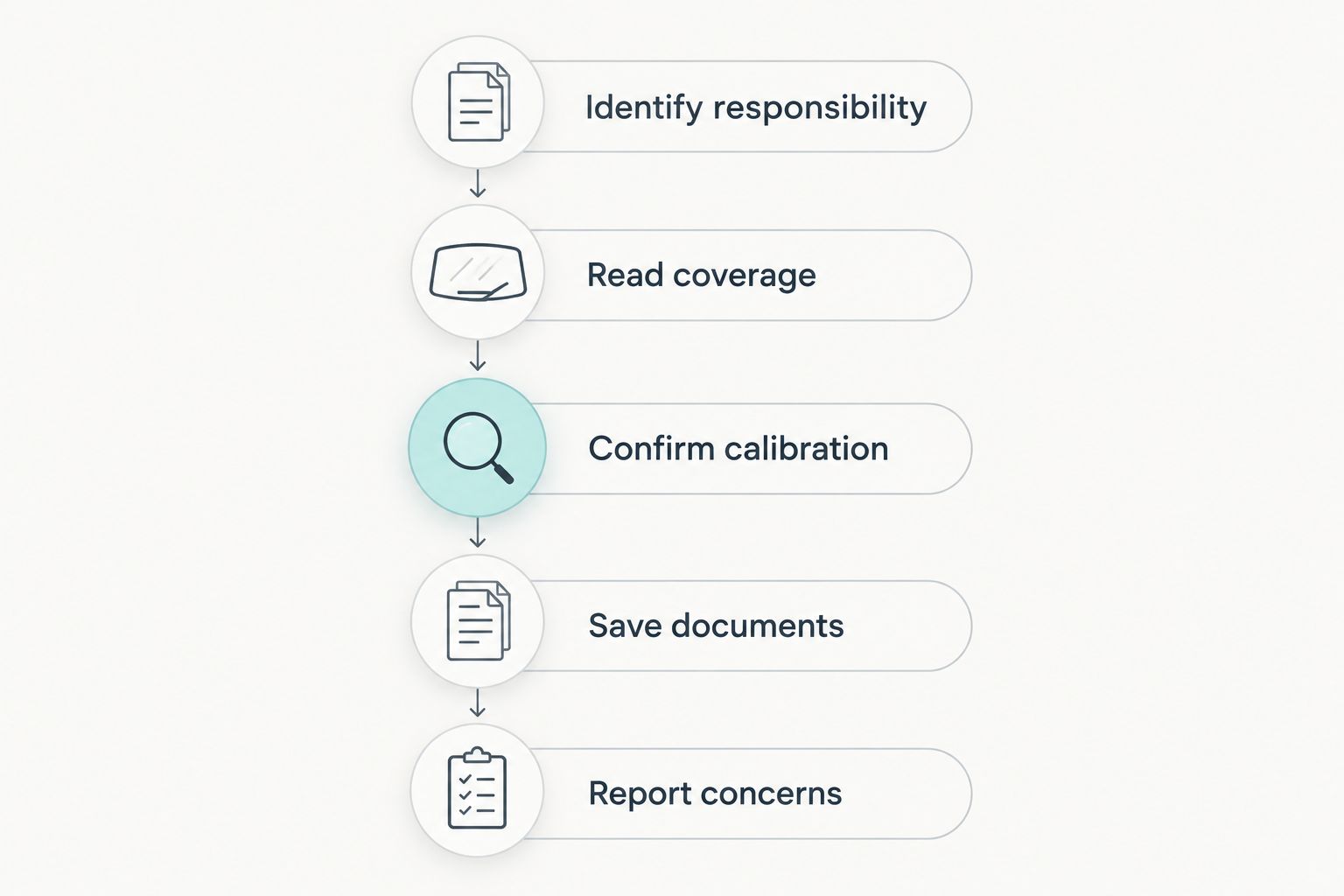
Follow this sequence before agreeing to glass work:
- Identify responsibility: Get the installation business and warranty issuer on the repair paperwork.
- Read coverage: Check the covered defects, corrective labor, exclusions, and duration.
- Confirm calibration: Ask whether the vehicle requires calibration and who handles it.
- Save documents: Keep the estimate, completed repair order, and written warranty together.
- Report concerns: Follow the stated inspection process if a problem appears.
Keep these 3 documents together: the estimate, completed repair order, and written warranty. They connect the promised work, the completed work, and the coverage terms.
Ask these 4 questions before authorization:
- Who issues the warranty?
- What corrective labor does a covered claim include?
- Where does the warranty inspection happen?
- Who handles required calibration and related concerns?
Avoid diagnosing a leak, noise, or warning message yourself. Describe what you observed and request an inspection. If a condition affects visibility or safe vehicle operation, address that concern before continuing to drive.
Which auto glass warranty provider should you choose?
Your default choice is the installer with clear written defect coverage and a correction process you can realistically use. Choose accident-repair coordination when glass damage belongs to a larger repair; choose cross-location service when travel matters; choose mobile service when access matters.
In 2026, compare the terms attached to your vehicle and repair—not a generic warranty slogan. A long coverage period does not answer whether corrective labor, required calibration, or a return inspection is included.
FAQ
What are the best auto glass warranty providers in 2026?
The best auto glass warranty providers are those that document covered defects, corrective labor, exclusions, and the claims process. Choose the provider type that fits your repair: the original installer for direct accountability, a collision center for accident-related work, or a mobile specialist for location convenience.
Is a lifetime windshield warranty always the best option?
No, a lifetime label does not establish what the warranty covers. Read the definition of lifetime, covered defects, exclusions, ownership conditions, and corrective-labor terms before comparing it with another warranty.
Does an auto glass warranty cover another rock chip?
Coverage for a new rock chip depends on the written terms. Check new-impact damage separately from installation defects, and review any applicable insurance coverage rather than assuming the installation warranty pays.
Is dealership windshield replacement better than an independent installer?
A dealership is not automatically the better warranty choice. Compare the actual installer, warranty issuer, covered corrective work, and calibration responsibility on each repair order.
What should I ask about windshield camera calibration?
Ask whether your vehicle requires calibration after replacement, who performs it, and who handles related concerns afterward. Request documentation of the work required for your vehicle rather than relying on a general promise.
Can another location handle my glass warranty claim?
Another location can handle the claim only when the provider's terms and authorization process permit it. Confirm cross-location service before booking if you travel frequently or expect to move.
Can a collision repair center help with accident-related glass replacement?
A collision repair center that provides auto glass replacement can address glass damage alongside other accident repairs. Ask for the glass-specific repair scope and warranty even when the work is part of a larger insurance claim.
One last thing
Put return access ahead of warranty length. A warranty is useful only if you understand where to report a concern and can follow its inspection process. Before leaving with the vehicle, save the warranty contact and ask what information the provider needs when you report a problem.