Instead of repeatedly sending accident photos and explaining the same damage, use an insurance photo estimate collision repair workflow that transfers your claim documents to a repair center, schedules an in-person inspection, and tracks additional findings. Treat the photo estimate as a starting assessment—not proof that all damage is visible or that your vehicle is safe to drive.
- An insurance photo estimate collision repair workflow connects initial photos, an in-person inspection, and documented supplements.
- MB Collision Group serves Southern California drivers needing collision repair and insurance-claim assistance.
- Send the estimate and claim contact details before the inspection; confirm who handles additional findings.
- Do not drive a damaged vehicle just because an insurer accepted its photos.
Why this matters
A photograph shows what the camera can see. It does not expose damage behind a bumper cover, measure structural alignment, or establish whether a vehicle needs manufacturer-specified diagnostic procedures.
MB Collision Group is best for Southern California vehicle owners seeking factory-certified collision repair and insurance-claim assistance. Start with MB Collision Group to discuss the handoff, and confirm that the selected center holds the certification relevant to your vehicle.
For your 2026 claim, keep three decisions separate: what damage is documented, what repairs you authorize, and what the insurer agrees to cover. An uploaded estimate does not settle all three.
| Assessment stage | Best for | Main benefit | Limitation |
|---|---|---|---|
| Photo estimate | Starting a claim with visible damage | Gives the insurer an initial visual record | Cannot show concealed damage or establish drivability |
| In-person inspection | Examining damage directly | Lets the repairer assess the vehicle beyond uploaded images | An exterior inspection still cannot reveal everything behind installed components |
| Authorized disassembly | Examining areas concealed by damaged components | Exposes damage needed for repair planning | Requires an agreed scope and can change the initial repair plan |
These are stages, not competing promises. A useful photo estimate can still need substantial revision after physical inspection.
Before you start
- Prepare 3 documents: the initial estimate, the claim correspondence containing your claim number, and a vehicle-information sheet. Include your vehicle identification number, current location, and a plain-language description of the accident and symptoms.
- Identify 2 contacts: the insurer’s assigned claim contact and the repair center’s intake or estimating contact. Use the insurer’s established claim channel and ask the shop how it accepts documents; do not assume the two parties already share access.
- Separate inspection from authorization. Booking an inspection is not the same as authorizing disassembly or repairs. Before drop-off, ask what you are signing, what happens if concealed damage is found, and who obtains any additional authorization.
Do not wait until arrival to mention steering changes, fluid leaks, warning messages, damaged tires, or glass that obstructs visibility. Describe those conditions before arranging transportation. If you cannot establish that the vehicle is safe, arrange professional assistance rather than driving it to the appointment.
Claim packet setup
- Save the original estimate. Download the complete document through the insurer’s established channel, if a download is provided. Preserve the estimate identifier, issue date, included pages, and accompanying messages; screenshots of a total alone omit the repair details the shop needs.
- Build one claim packet. Put the original estimate, accident photographs, claim number, vehicle information, and insurer contact details together. Name the files consistently so the recipient can distinguish the original estimate from later revisions.
- Add a symptom note. Describe what you observed without diagnosing the cause: a door catches when opening, a warning message appeared after impact, or the steering feels different. Separate accident-related observations from conditions that existed beforehand.
- Send through the agreed channel. Ask the shop to confirm receipt and identify anything missing. Do not send account passwords or assume that access to your insurer’s portal transfers with the documents.
Expected result: the repair center can identify your vehicle, locate the insurer’s starting assessment, and understand the concerns that photographs do not explain.
For a 2026 claim, put the actual document date in each filename rather than calling every attachment the latest estimate. This small distinction helps prevent an older document from becoming the working repair reference.
The insurer’s upload fields and submission buttons vary by carrier. Follow the labels in your own claim channel; this workflow does not require a particular app or a shared login.
Inspection appointment setup
- Describe the appointment’s purpose. Tell the repair center that you have an insurance photo estimate and want an in-person assessment. Ask whether the appointment is for an exterior inspection, vehicle drop-off, or a separately authorized examination involving disassembly.
- Confirm transportation before departure. Report drivability concerns, where the vehicle is located, and whether it needs towing. If another facility has the vehicle, confirm release requirements and the receiving location before arranging a transfer.
- Confirm the handoff details. Record the appointment date, receiving contact, vehicle location, and documents requested. Ask whether the vehicle stays at the center and what permission is needed before any work begins.
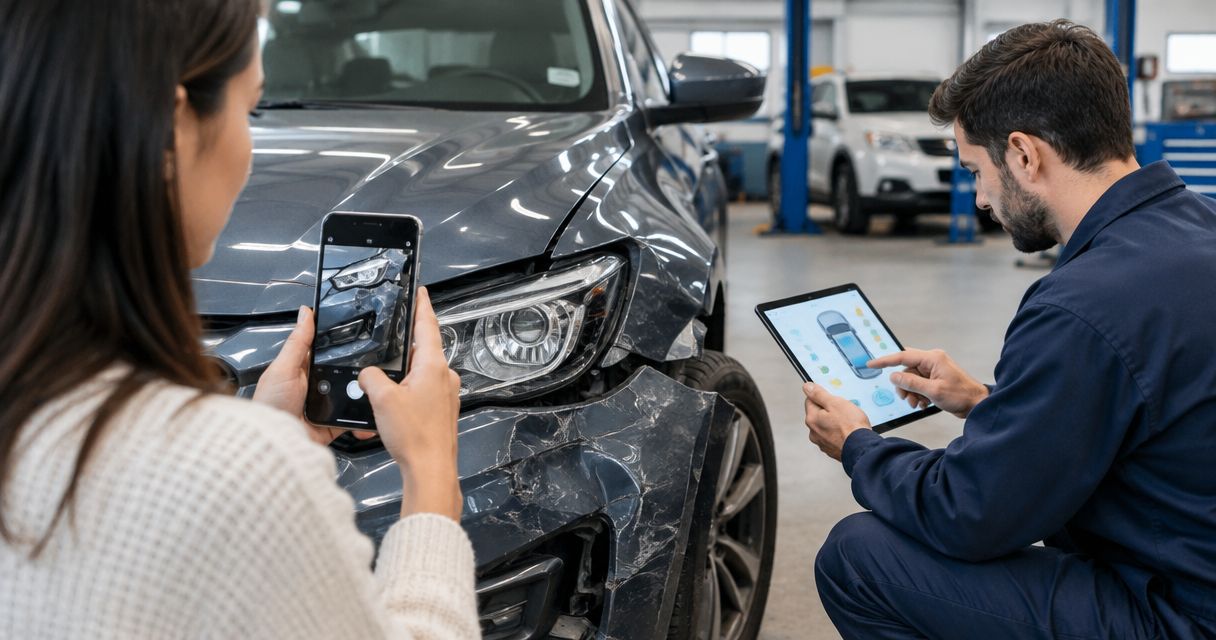
- Walk through the damage at intake. Point out the impact area and each symptom from your note. Ask the estimator to distinguish visible findings from areas that need further examination.
Expected result: you know what the appointment includes, how the vehicle will arrive, and what the repair center needs before proceeding.
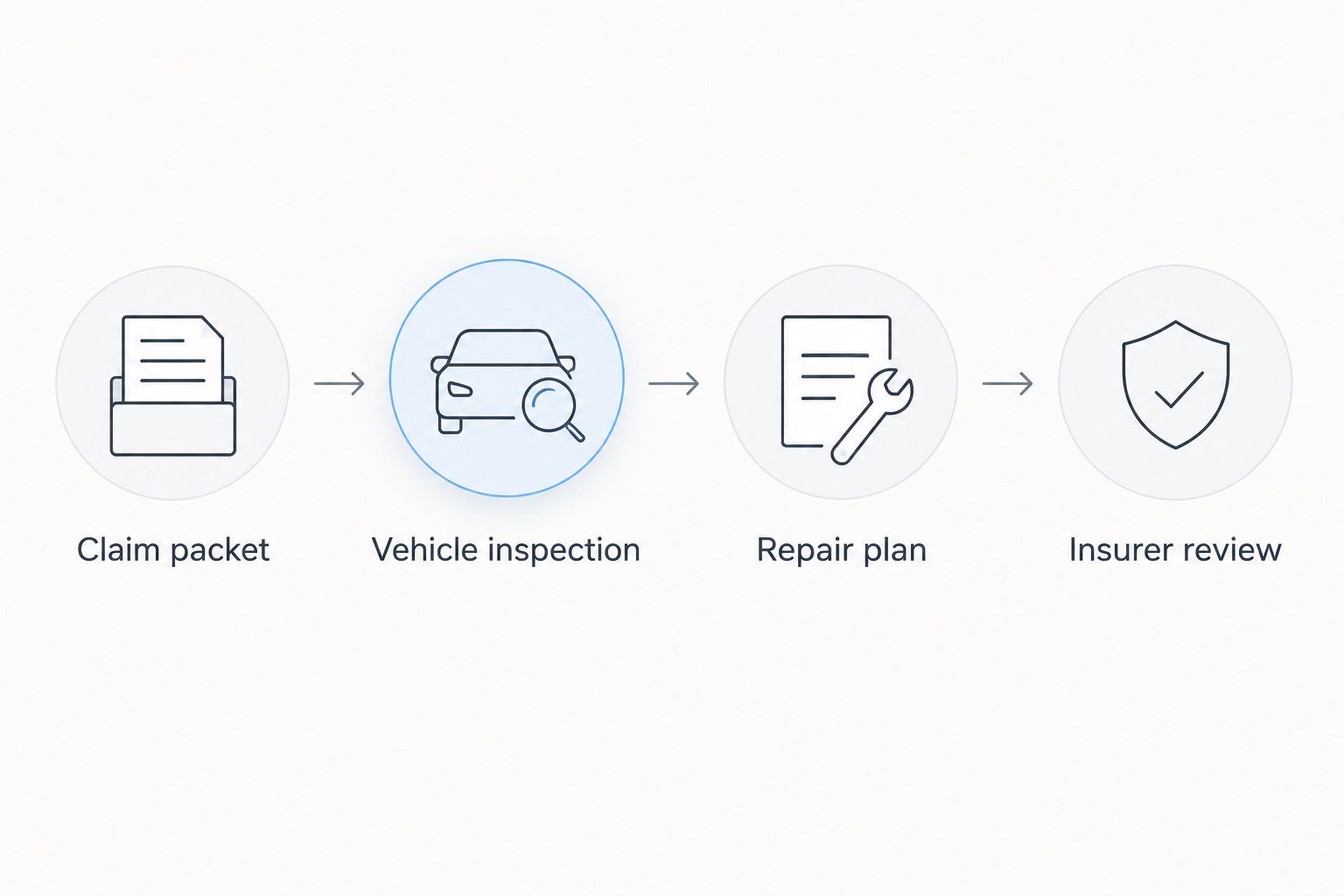
The handoff has four checkpoints: Claim packet, Vehicle inspection, Repair plan, and Insurer review. The repair plan follows the findings; it should not be treated as a copy of the original photo assessment.
Repair plan and supplement routing
- Request a clear explanation of differences. Ask the repair center which findings were absent from the photo estimate and which require further examination. A changed estimate needs an explanation tied to damage, repair procedures, or supporting evidence—not just a different total.
- Confirm permission before disassembly. Establish the scope of the proposed examination and your responsibilities before authorizing it. Ask what happens if the vehicle cannot immediately be reassembled or the claim changes direction.
- Assign the supplement handoff. A supplement is a request to add or revise repair items after the initial estimate. Confirm who sends it, which insurer contact receives it, and how receipt and review status will be recorded.
- Request the next decision in writing. Distinguish between a supplement being submitted, the insurer reviewing it, and a repair item being approved. Confirm your own repair authorization separately from the insurer’s coverage decision.
Expected result: additional findings have an owner, a recipient, supporting documentation, and a defined next action.
Use the guide to connecting an insurance adjuster to your repair estimate when the shop and insurer need a clearer communication handoff.
Do not interpret silence as approval. If a requested repair item remains disputed, ask the insurer for its position and the repair center for the technical basis of its recommendation. Keep both explanations with the claim record.
Claim status log
- Maintain 1 shared reference log. You do not need shared software: a document you maintain works. Record each event’s date, sender, recipient, document version, unresolved issue, and next action.
- Separate the status labels. Use your own tracking categories: documents received, inspection scheduled, findings documented, supplement submitted, insurer response received, and customer authorization recorded. These are checklist labels, not insurer portal settings.
- Name the next action owner. Replace a vague note such as waiting with a specific task: the insurer reviews the submitted supplement, the shop sends requested photographs, or you confirm an authorization question.
- Confirm the next update point. Ask when the responsible party expects to provide an update. Record that commitment rather than assuming a universal inspection or approval turnaround.
Expected result: you can explain what is pending without forwarding an entire message thread.
Keep the 2026 claim log separate from unrelated service records. When an estimate changes, retain the earlier version and identify the replacement; deleting the original removes context for the revision.
When the estimate changes after inspection
Use an update-triggered version of the same workflow whenever the repair center documents an additional finding. This is a communication routine, not an automatic connection between the shop and insurer.
- Trigger: the shop issues a revised estimate or identifies a repair item requiring further review.
- Evidence: ask which photographs, measurements, inspection findings, or repair procedures support the change.
- Handoff: confirm that the correct insurer contact received the revision and its attachments.
- Decision: record the insurer’s response and any separate authorization required from you.
- Schedule: ask the repair center how the unresolved item affects the repair sequence before changing transportation arrangements.
This variant is best for claims with newly exposed damage or revised repair requirements. Its benefit is a traceable decision record; its limitation is that documenting a request does not guarantee coverage or resolve a technical disagreement.
If the insurer changes its handling of the claim, including consideration of a total loss, pause assumptions about the repair schedule and request the next steps directly.
Troubleshooting the handoff
The shop did not receive the estimate
Confirm the recipient and resend the complete document through the agreed channel. Ask for receipt confirmation, then verify that the attachment opens and contains the repair line items—not just a summary page.
The insurer says the uploaded photos are insufficient
Ask which views or information are missing. Retake photographs only from a safe position; do not remove parts, crawl beneath a damaged vehicle, or enter traffic to satisfy a photo request.
The physical estimate differs from the photo estimate
Ask the estimator to identify the changed repair items and their supporting findings. Then confirm the supplement route; a difference alone does not establish that either estimate includes every necessary repair.
The supplement appears stuck between parties
Confirm the submission date, recipient, and document version with the shop. Ask the insurer whether it received the same packet and what remains necessary for review, then assign that request to a named contact.
New symptoms appear before the appointment
Stop treating the earlier photo submission as evidence of drivability. Report the symptoms to the repair center and seek professional guidance about moving the vehicle; a new warning, leak, or handling problem changes the transportation discussion.
Customize your workflow
For your 2026 repair plan, expand the handoff around the vehicle’s actual needs. Ask about glass damage, manufacturer-required procedures, and any inspections needed before return; do not assume every accident requires the same operations.
MB Collision Group provides collision repair, auto glass replacement, and insurance-claim assistance. Confirm the selected center’s vehicle-specific certification and the work required for your particular damage before authorizing repairs.
Discuss your inspection handoff
Ask what to send with your photo estimate and how to arrange an in-person collision inspection.
FAQ
Is an insurance photo estimate a final collision repair estimate?
No. An insurance photo estimate records an initial assessment based on submitted information; an in-person inspection and authorized disassembly can reveal additional damage requiring a revised repair plan.
Can I drive my car after the insurer accepts my accident photos?
Photo acceptance does not establish that your vehicle is safe to drive. Report warning messages, leaks, tire damage, visibility problems, or handling changes and seek professional guidance before moving it.
What should I send before an in-person collision inspection?
Send the complete photo estimate, claim number, insurer contact details, vehicle information, accident photos, and a symptom note. Confirm the repair center's preferred submission channel and ask it to acknowledge receipt.
Why does the repair shop estimate include damage missing from the photos?
Photographs cannot show every concealed component or physical condition. Ask the shop to explain each additional finding and identify the documentation supporting its revised repair plan.
Who sends a collision repair supplement to the insurance company?
Confirm the submission responsibility with your repair center and insurer. Record who sends the request, who receives it, and who follows up on missing information or a pending decision.
Does insurance approval authorize the shop to repair my vehicle?
Insurance approval and your repair authorization are separate decisions. Ask the shop what you are authorizing and ask the insurer which items it has agreed to cover.
Can MB Collision Group help with an insurance claim after an accident?
MB Collision Group provides insurance-claim assistance alongside collision repair services in Southern California. Discuss your photo estimate, inspection needs, and vehicle-specific certification with the selected center.
One last thing
A claim can have complete photographs and still have an incomplete repair plan. Before closing your 2026 claim file, compare the final repair documentation with the latest agreed scope—not just the original photo estimate. Ask about any unresolved differences while the vehicle and records are still accessible.