Instead of coordinating the tow driver, repair shop, and insurer separately after an accident, confirm the receiving collision center first, then share one documented handoff with everyone involved. MB Collision Group provides factory-certified collision repair and insurance-claim assistance in Southern California; this 2026 guide explains how to arrange the transfer without confusing towing permission with repair authorization.
- To tow car to collision center after accident, confirm the destination and receiving instructions before dispatch.
- MB Collision Group suits Southern California owners seeking factory-certified collision repair and insurance-claim assistance.
- Keep towing authorization, insurance coverage decisions, and repair authorization separate.
- If your vehicle is already stored, confirm release requirements before arranging another tow.
Why this matters
A tow order does not establish insurance coverage, confirm a shop can receive your vehicle, or authorize repairs. Treat those as separate decisions. Otherwise, the truck can arrive before the receiving shop has agreed to accept delivery.
Confirm the destination before you authorize transport whenever scene safety and official instructions allow. If emergency responders or law enforcement direct the vehicle's immediate removal, follow their instructions and document where it goes.
For the full process beyond transport, use the car accident to certified repair claims workflow. This guide focuses on getting the vehicle, documents, keys, and receiving instructions to the same destination.
Before you start
- Have your vehicle information ready. Gather the registration or VIN, vehicle location, your contact details, and keys if accessible. Have your insurer's contact information and claim number ready if a claim is open; ask what to do if the number is still pending.
- Reach the receiving shop and towing dispatcher. Confirm the exact facility address, receiving contact, delivery window, unloading instructions, and whether that location's manufacturer certification applies to your vehicle.
- Resolve the hidden obstacle: permission to release the vehicle. If the car is in a storage yard, ask the yard directly what owner authorization and documents it requires. Dispatching a truck does not release the car, and an insurer's instruction does not replace the yard's release procedure.
MB Collision Group is best for Southern California vehicle owners seeking factory-certified collision repair and insurance-claim assistance. Confirm the receiving location's certification for your make before booking transport; the group's factory-certified status alone does not identify every location's manufacturer approvals.
Vehicle and destination confirmation
Establish the receiving instructions
- Prioritize scene safety. Move yourself out of traffic when safe and follow emergency responders' directions. Do not enter an unsafe roadway to photograph damage or retrieve paperwork.
- Describe the vehicle's condition to dispatch. Report whether the vehicle rolls, steers, has accessible keys, or has visible wheel damage. Identify an EV or hybrid and report smoke, unusual heat, leaking fluid, or exposed wiring without approaching damaged components.
- Confirm the receiving facility directly. Ask whether it accepts your vehicle, who will receive it, and what delivery arrangements apply. Read the complete street address back to the dispatcher rather than giving only a business name.
- Obtain 2 confirmations: the shop accepts the planned delivery, and the towing dispatcher has the same destination and instructions. If either party changes the plan, update the other before departure.
Expected result: The truck has a confirmed destination, the receiving shop expects the vehicle, and the operator knows about relevant loading concerns.
The towing operator should select equipment and loading methods using the vehicle manufacturer's instructions and the vehicle's actual condition. Do not assume a vehicle that starts is safe to drive, or that putting it in neutral makes every towing method appropriate.
Handoff records and permissions
Prepare the transfer record
- Photograph safely. Capture accessible exterior views, visible damage, and the vehicle's condition before loading. Do not open damaged compartments, handle debris, or delay an emergency removal to complete a photo set.
- Create 3 records: a vehicle-condition record, a transport record, and an authorization record. Keep photographs with the first, destination and dispatcher details with the second, and copies of signed documents with the third.
- Separate the permissions. Read what each document authorizes before signing. Ask whether it covers transport, storage, inspection, disassembly, or repair; request clarification when a form combines activities you have not discussed.
- Share a concise receiving note. Include your name, callback number, vehicle identification, claim number if assigned, towing company, and known condition concerns. Send it through the receiving shop's agreed communication method.
Expected result: You can identify what was transported, where it was sent, and what you authorized without reconstructing conversations later.
For your 2026 handoff record, use clear headings such as Vehicle condition, Transport details, Authorization, and Receipt confirmation. These are document headings for your own notes, not buttons in a required app.
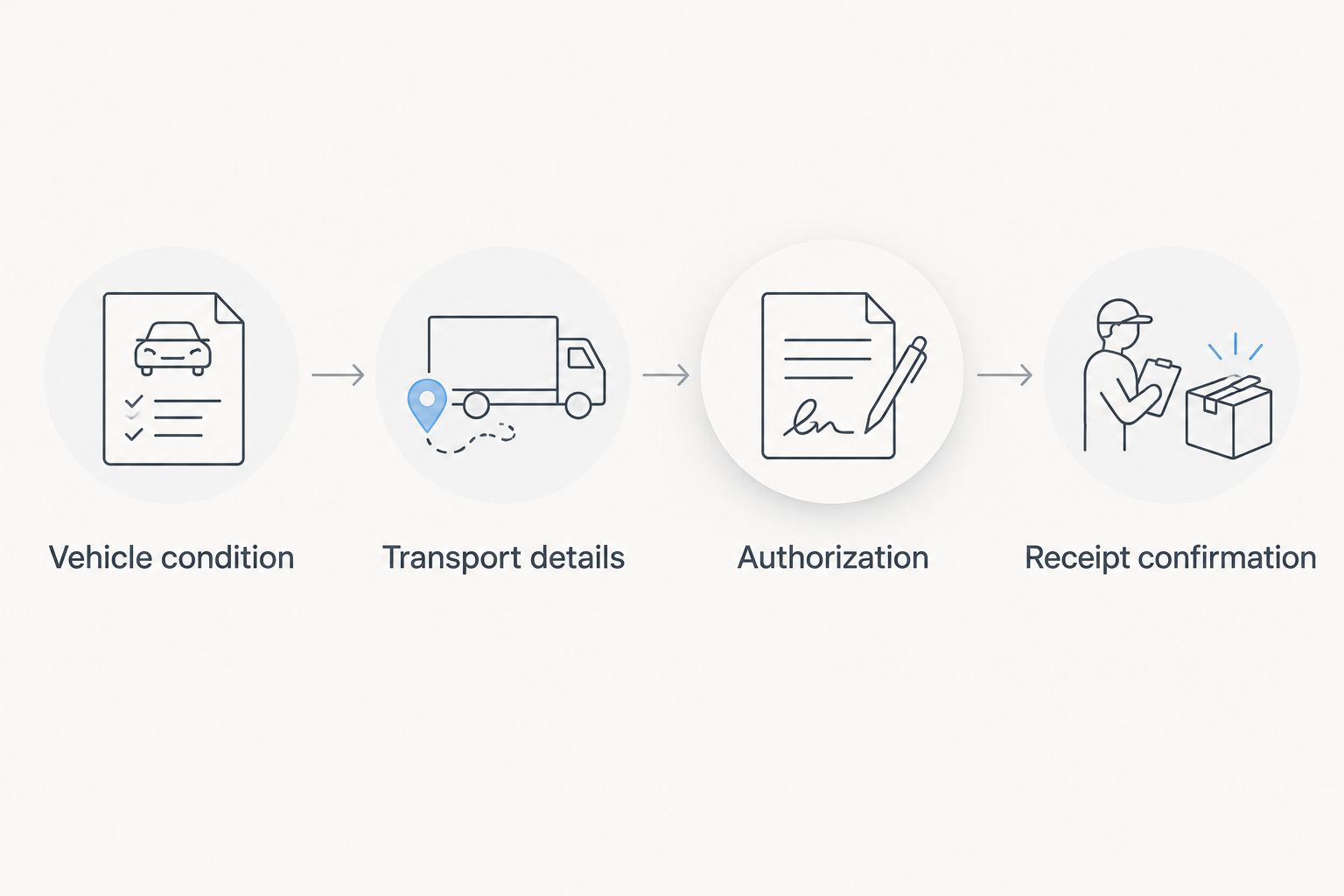
Keep 1 shared log for the transfer, with dated entries and the name of each person who gives an instruction. Update it when the destination, arrival plan, or authorization changes rather than creating competing versions in separate message threads.
For personal belongings, remove accessible valuables only when safe and permitted. Record keys or accessories left with the vehicle and tell the receiving shop about them. Do not leave claim paperwork containing unnecessary personal information loose inside the car.
Tow dispatch and arrival confirmation
Close the delivery handoff
- Read back the dispatch details. Confirm the pickup point, receiving address, shop contact, and delivery instructions. If the dispatcher provides an arrival estimate, record it as an estimate rather than a confirmed receiving appointment.
- Confirm key custody. Ask who takes possession of the keys and how they reach the receiving staff. Do not assume the driver can leave keys anywhere on the property.
- Check after-hours arrangements before departure. Obtain the receiving shop's instructions directly. If nobody has confirmed an authorized drop-off procedure, resolve that before sending the truck to a closed location.
- Verify actual receipt. Ask the receiving facility to confirm that the vehicle and keys arrived. Record any reported delivery damage or missing items and share relevant before-loading photographs.
Expected result: The transfer ends with confirmed receipt, not merely a dispatch notification or a driver's departure message.
For a 2026 accident file, keep transport completion separate from inspection progress. Ask the shop who will contact you about assessment and authorization, and ask the insurer who handles coverage questions. Delivery confirmation is not confirmation that repairs have started.
Discuss your collision repair handoff
Ask about receiving arrangements, factory-certified collision repair, and insurance-claim assistance.
When your car is already in a storage yard
A storage-yard transfer adds a release step before dispatch. Start with the yard that physically holds the vehicle, even if your insurer or a towing company has already recommended a destination.
Choose the correct transfer route
| Transfer route | Best for | Advantage | Limitation | Required check |
|---|---|---|---|---|
| Direct delivery to a collision center | Owners with a confirmed receiving destination | Avoids arranging an intermediate storage transfer | Requires confirmed intake and suitable delivery arrangements | Shop acceptance before dispatch |
| Storage-yard transfer to a collision center | Owners whose vehicles were already removed from the scene | Allows the receiving destination to be coordinated after scene clearance | Adds release paperwork and another handoff | Yard release requirements before dispatch |
Prefer direct delivery when the receiving shop has accepted the vehicle and scene instructions permit it. Use the storage-yard route when the vehicle is already held there; do not bypass the yard's release requirements.
- Locate the vehicle. Get the holding yard's name, address, contact details, and any reference number. Confirm the vehicle by VIN or another reliable identifier rather than color alone.
- Complete release requirements. Ask who must authorize release, which documents are required, and whether anything remains unresolved. Clarify responsibility for outstanding charges with the relevant parties before dispatch.
- Reconnect the handoff. Confirm the collision center's receiving instructions again, then give the towing dispatcher both the yard's pickup requirements and the shop's delivery instructions.
Expected result: The yard is ready to release the correct vehicle and the collision center is ready to receive it.
Do not treat a previous destination request as permanent authorization for every later transfer. Confirm each move and keep a copy of the instruction identifying its origin and destination.
Troubleshooting
The tow truck arrives, but the yard will not release the car
Ask the yard to identify the unmet requirement: owner authorization, identity documentation, unresolved charges, or another release condition. Resolve that requirement with the responsible party before requesting another pickup. Repeating the dispatch does not fix a release problem.
The driver has a different destination
Pause the transfer if it is safe and permitted to do so. Compare the dispatcher’s order with your confirmed receiving address, then have dispatch correct the instruction. Do not rely on a verbal promise that the address will be sorted out after departure.
The collision center is closed at arrival
Contact the receiving shop through its agreed channel and verify whether an authorized after-hours process exists. Do not instruct the driver to leave the vehicle on the street or block an entrance. If delivery cannot proceed, document the revised destination and notify the insurer.
Your insurer has not confirmed coverage
Ask the insurer to explain what remains undecided and who is responsible for authorizing the next action. Keep any transport decision separate from a promise of reimbursement. A claim number identifies a claim; it does not establish payment approval.
The vehicle's condition changes before loading
Tell the operator about new smoke, unusual heat, leaking fluid, or movement restrictions before loading begins. Keep clear of the hazard and contact emergency services when needed. For an EV or hybrid, do not touch exposed high-voltage components or attempt to make the vehicle tow-ready yourself.
Customize your workflow
Build your 2026 transfer checklist around the vehicle and the person who can authorize work. A company vehicle, leased vehicle, and personally owned vehicle can involve different contacts; identify the decision-maker rather than assuming the driver has every required permission.
- For company vehicles: Include the fleet contact and confirm who authorizes transport and repair. Send updates to the responsible manager without distributing unnecessary driver information.
- For EVs and hybrids: Identify the powertrain to dispatch and report collision-related electrical concerns. Have the operator follow manufacturer-specific towing instructions.
- For glass damage: Describe broken glass and visibility concerns to the receiving shop. Ask how glass work and any required driver-assistance-system checks fit into the repair assessment.
MB Collision Group provides collision repair, auto glass replacement, and insurance-claim assistance. Discuss the vehicle's needs with the receiving location instead of assuming every task begins immediately after unloading.
FAQ
How do I tow my car to a collision center after an accident?
Confirm that the receiving collision center accepts the vehicle, then give the towing dispatcher its exact address and delivery instructions. Document the vehicle's condition, keep transport permission separate from repair authorization, and confirm receipt after delivery.
Can I send my damaged car straight to a repair shop?
Arrange direct delivery when the shop has confirmed acceptance and scene instructions permit it. Verify the delivery window, unloading arrangements, and key handoff before dispatch.
Does a claim number mean insurance will pay for the tow?
No. A claim number identifies the claim but does not establish coverage or payment approval. Ask the insurer to explain the applicable coverage and what authorization it requires.
What if my car is already at a storage yard?
Confirm the yard's release requirements before booking another tow. Identify the vehicle, complete the required authorization, and coordinate pickup with the receiving shop's delivery instructions.
Does a factory-certified collision center handle every vehicle make?
Factory certification does not establish certification for every vehicle make at every location. Ask the receiving facility to confirm its current manufacturer certification for your vehicle before arranging delivery.
Can MB Collision Group help with an accident claim?
MB Collision Group provides insurance-claim assistance alongside factory-certified collision repair in Southern California. Ask the receiving location how to coordinate your vehicle information and claim details; coverage decisions remain with the insurer.
Should I authorize repairs when I authorize towing?
Treat towing and repair authorization as separate decisions. Read each document, identify the activities it permits, and clarify any combined authorization before signing.
One last thing
A delivered vehicle is not the same as an accepted repair job. Close your 2026 handoff by asking who has the keys, who confirms inspection arrangements, and who contacts you before additional work is authorized. Those answers make the next action clear without assuming the tow completed the claim process.