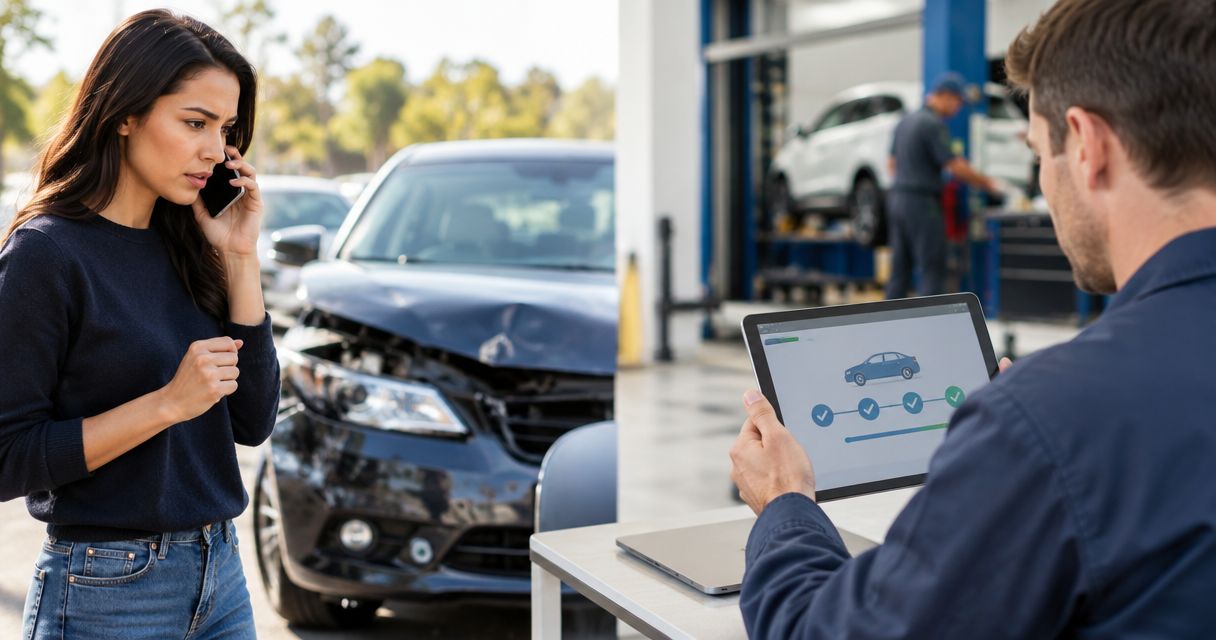
Instead of arranging glass replacement and then chasing a separate camera-calibration appointment, coordinate both under one vehicle-specific repair plan. For windshield replacement ADAS calibration in 2026, confirm the manufacturer's requirements before removal, complete the specified calibration after installation, and collect the results before accepting the vehicle.
- Windshield replacement ADAS calibration follows the vehicle manufacturer's procedure, not a universal reset sequence.
- MB Collision Group serves Southern California owners needing auto glass replacement and collision-repair assistance.
- Static calibration, dynamic calibration, or both depend on the vehicle and repair procedure.
- A clear dashboard does not replace documented calibration results and required verification.
Why this matters
A windshield-mounted camera looks through the glass to support driver-assistance functions. Replacing that glass changes an important part of the camera's installation environment; the manufacturer's repair instructions determine the required calibration and checks.
MB Collision Group is best suited to Southern California vehicle owners seeking auto glass replacement alongside collision-repair and insurance-claim assistance. Discuss the glass repair and any associated calibration requirements with MB Collision Group before authorizing work. Confirm who will perform each operation rather than assuming factory certification covers every vehicle or calibration procedure.
This is a coordination guide for your 2026 repair, not a technician's calibration procedure. Target positions, scan-tool commands, road conditions, and acceptance criteria belong to the exact vehicle's service information. Do not substitute a generic online sequence.
Before you start
- Gather vehicle and claim details. Provide the 17-character vehicle identification number, registration information, damage photos, and insurance claim details if applicable. Describe existing warning messages and any recent glass, suspension, alignment, or collision work.
- Confirm technical access. The repair provider needs current manufacturer service information, suitable diagnostic and calibration equipment, and the required working conditions. Ask whether calibration is performed at the repair location or coordinated elsewhere.
- Resolve the scheduling gotcha. Adhesive safe-drive-away requirements and calibration readiness are separate conditions. A replacement windshield being installed does not establish that the vehicle is ready for a road-based calibration or customer pickup.
Ask for the complete sequence before booking transportation. A glass appointment and a calibration appointment are not interchangeable, and an outside calibration provider adds a handoff that needs an identified owner.
Vehicle identification and repair scope
Establish the requirements before glass removal
- Identify the exact vehicle. Give the repair provider the VIN and ask the provider to verify the fitted camera and driver-assistance equipment. A model name alone does not identify every equipment variation.
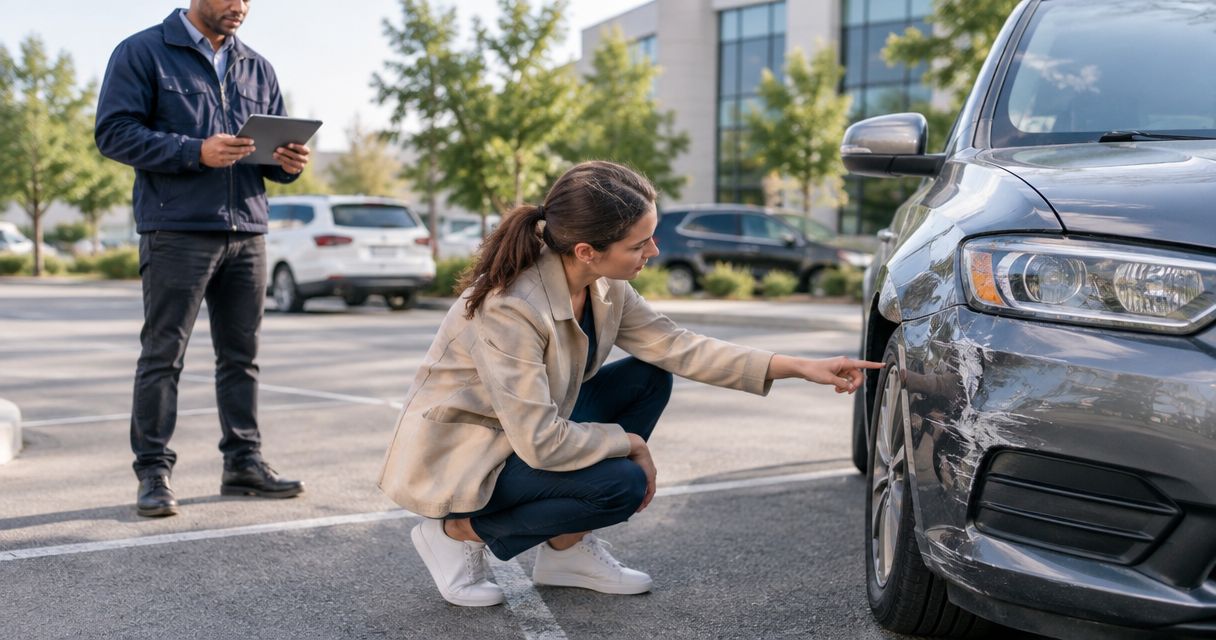
- Describe the event. State whether the windshield damage occurred alone or during a collision. Include steering changes, warning messages, and damage around the roof, mirror area, bumper, or suspension.
- Request the applicable procedure. Ask which manufacturer instructions govern glass replacement, camera handling, calibration, and final verification. Do not accept a generic statement that all vehicles receive the same reset.
- Define responsibility. Identify who replaces the glass, who performs calibration, who receives the results, and who authorizes vehicle release. If another facility performs calibration, confirm how the vehicle reaches it safely.
- Separate authorization from technical necessity. Ask the shop to explain required operations and document any insurance authorization still outstanding. An unresolved claim decision does not change the manufacturer's repair requirements.
Expected result: You have a written scope connecting the correct vehicle, the glass operation, the required calibration procedure, and the responsible provider.
For a 2026 repair file, request the procedure applicable at the time of repair rather than relying on instructions from an earlier glass replacement. Record the vehicle identity on every report so documents from separate providers remain connected.
Choose the required calibration method
The correct method is prescribed, not selected for convenience. These are procedure types, not competing services you can freely swap.
| Procedure | Best for | What happens | Advantage | Constraint |
|---|---|---|---|---|
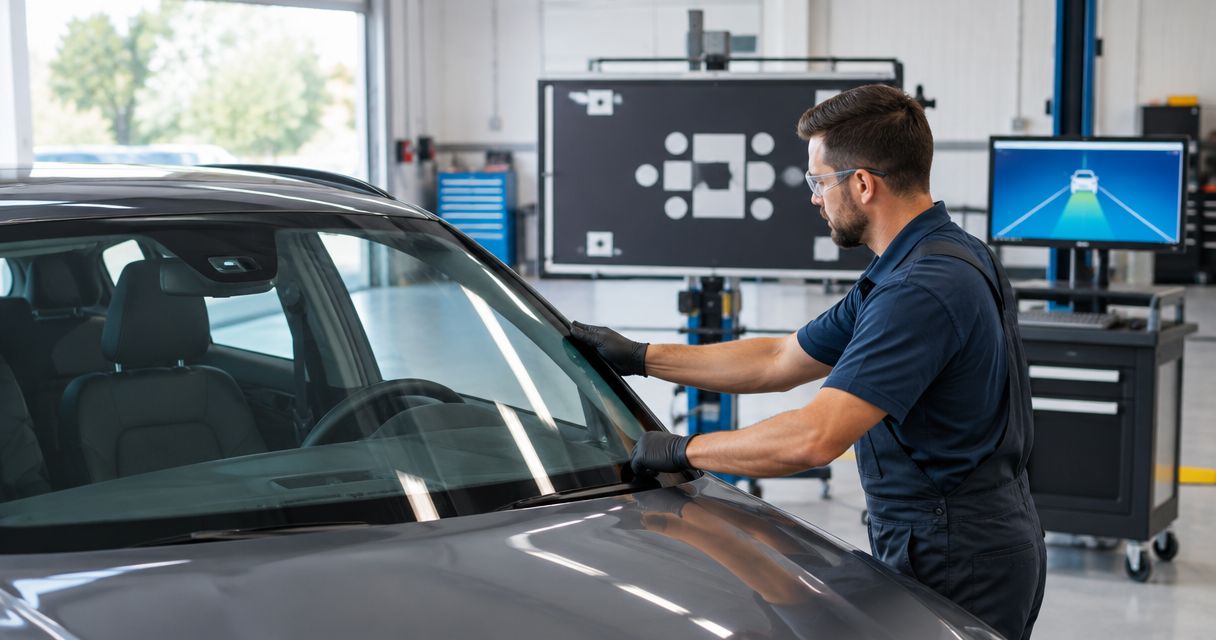
| Static calibration | Vehicles whose manufacturer specifies a stationary target procedure | A technician positions the vehicle and calibration equipment according to service information | Does not depend on completing a calibration drive when the procedure is entirely stationary | Requires the specified space, positioning, equipment, and environmental conditions |
| Dynamic calibration | Vehicles whose manufacturer specifies a driving procedure | A technician follows the prescribed road-based learning or calibration process | Performs the prescribed learning process while the vehicle is moving | Requires suitable road, visibility, speed, and other specified conditions |
| Combined procedure | Vehicles whose instructions require stationary and driving stages | The provider completes both stages in the specified sequence | Covers both required parts of the procedure | Completion of one stage does not establish completion of the other |
Use the manufacturer's required method, even when another method fits the appointment more easily. A shop should explain the selected procedure and its prerequisites without promising that the same method suits every vehicle.
Glass installation and calibration readiness
Prepare the vehicle before calibration
- Verify glass suitability. Ask the installer to confirm that the replacement windshield matches the vehicle's specified features, camera viewing area, and mounting requirements. Do not treat visual similarity as proof of suitability.
- Document camera handling. Have the provider record camera removal, refitting, replacement, or bracket concerns as applicable. A damaged or incorrectly fitted mount needs attention before calibration.
- Complete the installation requirements. The installer follows the glass and adhesive instructions, including the applicable safe-drive-away conditions. Ask for the release instruction that applies to your installation rather than assuming a standard waiting period.
- Check calibration prerequisites. The technician verifies the conditions required by the manufacturer, such as tire pressures, vehicle loading, alignment status, battery support, and camera visibility where specified.
- Keep the sequence explicit. Confirm whether remaining collision, suspension, or alignment work must precede calibration. Work that changes the vehicle's geometry or sensor installation can affect the calibration plan.
Expected result: The glass is installed, relevant defects are addressed, and the vehicle meets the prerequisites for its specified calibration procedure.
For your 2026 appointment, ask which events trigger a scheduling update. Examples include unsuitable calibration conditions, unresolved vehicle faults, or additional damage discovered during removal. The useful answer identifies the next action and responsible person, not just a revised pickup estimate.
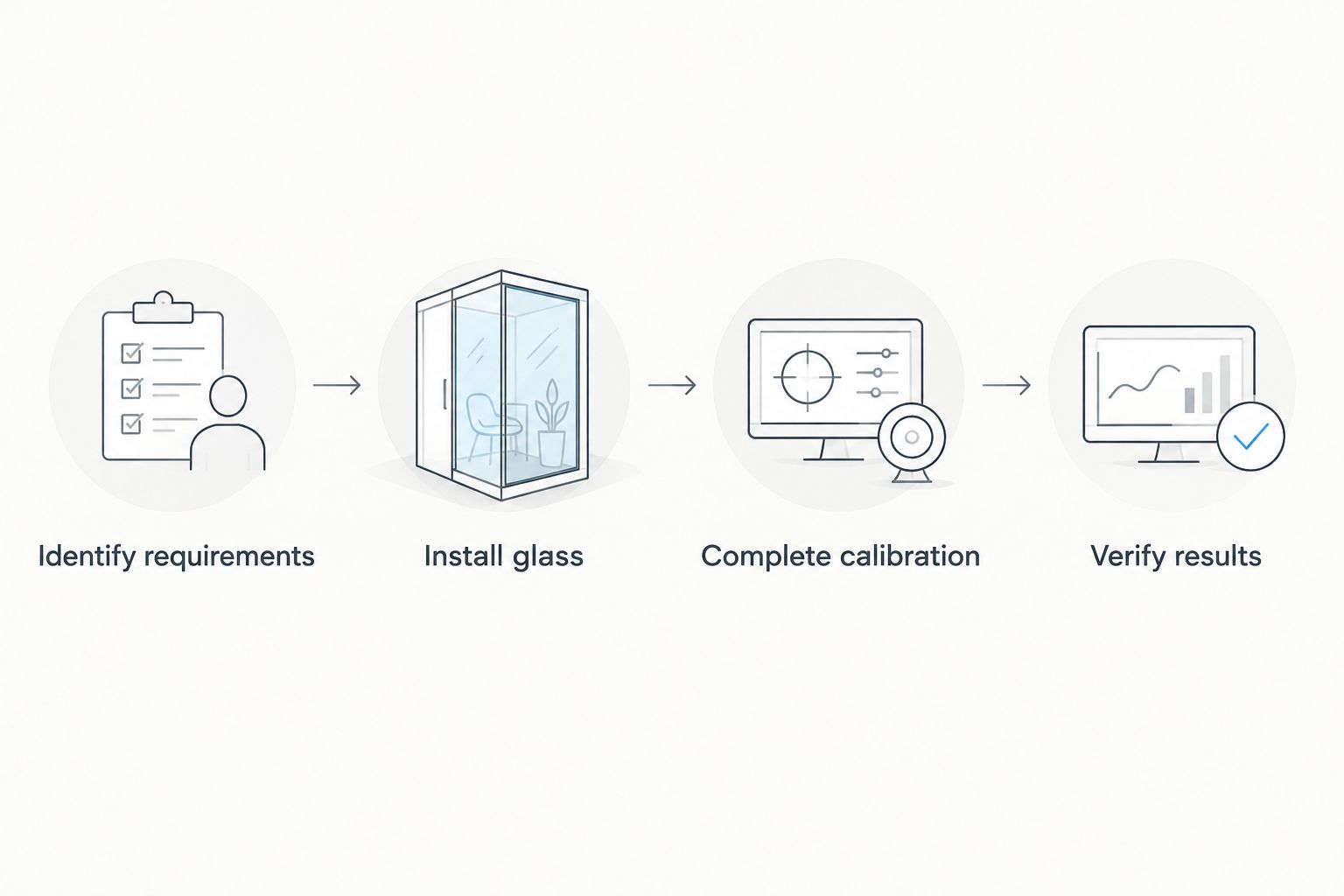
The sequence matters more than the location of each operation. If glass installation and calibration occur at different facilities, carry the vehicle identity, installation details, and outstanding prerequisites through the handoff. Avoid making yourself the only person connecting the providers.
Calibration execution and release records
Verify completion before accepting the vehicle
- Have the qualified provider perform the procedure. Calibration uses the manufacturer's specified equipment, setup, and sequence. Do not attempt to replace that process with a dashboard reset, battery disconnection, or an ordinary drive.
- Request the completion result. Ask for the calibration record identifying the vehicle, system, procedure, and outcome. An invoice line saying calibration was billed is not the same as a recorded successful result.
- Review unresolved faults. Ask the provider to explain relevant diagnostic findings and any remaining warning messages. A diagnostic scan and a calibration answer different questions; one does not automatically replace the other.
- Confirm required final checks. The provider completes the manufacturer's specified post-repair checks, including any required road verification. A successful calibration message is not permission to ignore another unresolved safety-related condition.
- Collect the handover instructions. Obtain adhesive-related driving restrictions, care instructions, and directions for responding to returning warnings. Ask whom to contact if the glass repair and calibration were handled by different businesses.
Expected result: You receive documented completion, an explanation of outstanding findings, and clear vehicle-release instructions.
Keep 3 documents together: the repair invoice, the calibration result, and the written handover instructions. These are categories for organizing your file, not a substitute for additional records the specific repair requires.
Use 2 release checks: confirm the installation's driving conditions have been satisfied, and confirm the required calibration and verification are complete. Passing only one check does not resolve the other.
Owners coordinating glass work through MB Collision Group should confirm the calibration arrangements for their specific vehicle before authorizing the repair. The benefit is coordinating glass, collision, and claim-related needs; the limitation is that a general service description does not establish the equipment or procedure available for every vehicle.
Repeat the workflow after related repairs
Windshield replacement is not the only event that calls for reviewing calibration requirements. Camera removal or replacement, relevant collision repairs, and certain alignment or suspension operations also require checking the vehicle manufacturer's instructions.
For this adjacent workflow, start with the changed component rather than assuming the earlier windshield calibration remains sufficient:
- Identify the new repair or adjustment and the affected systems.
- Check whether the manufacturer specifies inspection, initialization, calibration, or another operation after that work.
- Complete prerequisites and the prescribed procedure in the required order.
- Attach the new results to the repair file and explain what was repeated.
Expected result: Later work receives its own procedure check instead of inheriting an unsupported assumption from the earlier repair.
If you lease the vehicle, preserve the documentation for your own records and review any applicable lease requirements. The auto glass replacement guide for leased vehicle owners addresses that ownership context; it does not replace manufacturer repair instructions.
Troubleshooting
Calibration will not complete
Ask the provider to check the prerequisites and diagnostic results before repeating the same attempt. Incorrect setup, unsuitable environmental conditions, vehicle faults, or installation concerns require correction according to the applicable procedure. Repeated attempts alone do not prove the vehicle is ready.
A warning remains after calibration
Request diagnosis of the remaining warning and a written explanation of its relationship to the repair. Do not accept clearing the message as proof that its cause has been corrected. Follow the vehicle's warning instructions and obtain direction before driving.
The glass is installed, but road calibration cannot proceed
Ask which specified condition is unmet and how completion will be arranged. If a required driving procedure cannot be completed, reschedule that operation and clarify safe transport or holding arrangements rather than treating the repair as finished.
The camera area looks obstructed or incorrectly fitted
Report visible concerns around the camera cover, mounting area, or viewing zone to the installer. Do not reposition the camera or remove its cover yourself. The provider must inspect the installation and determine whether correction and further calibration are required.
A warning returns after pickup
Record the message and the circumstances, then contact the responsible provider. Do not deliberately test emergency braking or lane intervention on public roads. Follow the owner's manual and arrange inspection rather than relying on the absence of a constant warning.
Customize your workflow
For a straightforward glass repair, concentrate on the vehicle-specific procedure and the handoff between installation and calibration. For collision damage, connect glass work with structural, suspension, alignment, and other sensor-related operations before setting the final sequence.
Build your 2026 repair request around the outcome: correctly installed glass, completed required calibration, and documented release checks. Ask MB Collision Group how those responsibilities will be coordinated for your vehicle; confirm rather than assume whether each operation occurs at the same location.
For a work vehicle, also identify who authorizes additional repairs and who receives the completion records. That prevents a technically finished job from becoming an unresolved administrative handoff.
FAQ
Do I need ADAS calibration after windshield replacement?
Follow the vehicle manufacturer's requirements for the exact vehicle and repair. A windshield-mounted camera makes checking those requirements essential; the absence of a warning does not establish that calibration is unnecessary.
Can I drive immediately after windshield replacement and calibration?
Drive only after the installation's applicable safe-drive-away conditions and required repair-release checks are satisfied. Ask the provider for your vehicle's written instructions rather than assuming a universal waiting period.
Is static calibration better than dynamic calibration?
Neither method is universally better; the manufacturer specifies the required procedure. Some vehicles require stationary calibration, some require a driving procedure, and some require both.
Can I calibrate the windshield camera myself?
Do not substitute a home reset or an ordinary drive for the prescribed calibration. The procedure requires appropriate service information, equipment, setup, and verification by a qualified provider.
Does a clear dashboard mean ADAS calibration passed?
No. A clear dashboard does not replace the required calibration result and post-repair verification. Ask for records identifying the vehicle, procedure, and outcome.
Will insurance cover calibration after windshield replacement?
Coverage depends on the policy, claim, and authorization. Ask the repair provider to document required operations and confirm claim handling with the insurer before work begins.
What should I ask MB Collision Group before booking auto glass replacement?
Ask MB Collision Group who will verify the manufacturer's calibration requirements, perform any required calibration, and provide the completion records. Also confirm how installation restrictions and any outside-provider handoff will be handled.
One last thing
An uneventful drive home is not a calibration report. Driver-assistance functions operate under particular conditions, so normal driving impressions do not verify every required repair operation. For your 2026 repair file, ask for the result before pickup—not after a warning appears.