Instead of manually repeating your accident details to every contact, use a separate emergency, towing, insurance, and repair handoff for your mercedes benz mbrace crash notification repair workflow. A crash alert is not repair authorization: confirm your safety first, then arrange transport and verify the receiving shop’s certification before approving work.
- Mercedes-Benz mbrace crash notification repair requires a separate towing, insurance-claim, and repair-authorization handoff.
- MB Collision Group serves Southern California drivers needing collision repair and insurance-claim assistance; verify Mercedes-Benz certification for the receiving location.
- Check connected-service status for your specific vehicle in 2026; never depend on an unverified crash-alert feature.
- Keep emergency response, vehicle transport, insurance review, and repair authorization separate in your records.
Why this matters
An emergency notification, an insurance claim, and a repair order serve different purposes. Treating them as one transaction leaves important questions unanswered: where your car is going, who can approve work, and whether the receiving location has the certification your vehicle requires.
MB Collision Group is best for Southern California vehicle owners seeking collision repair and insurance-claim assistance. The group operates factory-certified centers, but confirm Mercedes-Benz certification for the specific location and vehicle before arranging delivery. Start with MB Collision Group to identify the receiving center rather than assuming every location has identical credentials.
For a 2026 repair handoff, use your vehicle’s current documentation and confirmed service status. The mbrace name alone does not establish which connected features work on your particular car.
Before you start
- Vehicle information and service access: Gather your 17-character vehicle identification number, registration, current contact details, and access to the vehicle’s connected-services account if you use one. Verify emergency-feature instructions against the vehicle’s own manual.
- Claim and transport information: Have your insurance details, claim number if already assigned, tow operator’s contact information, vehicle location, and proposed repair destination. If someone else coordinates the repair, establish what permission they need.
- The gotcha: Do not assume an account login, crash notification, or emergency call has opened a claim or booked a certified repair appointment. Confirm each handoff independently; do not interrupt emergency assistance to complete paperwork.
If anyone is injured or there is immediate danger, contact 911 when you can do so safely. Follow emergency responders’ directions before collecting documents, photographing damage, or arranging a preferred destination.
Vehicle and emergency-service verification
Establish the vehicle record
- Confirm the vehicle identity. Copy the VIN from your registration or another reliable vehicle record. Match it to the car involved, especially if your household or business operates several vehicles.
- Check the actual service status. Use current Mercedes-Benz documentation or support for your VIN to establish which emergency and connected-service functions operate on the vehicle in 2026. Do not use a generic online walkthrough as proof of compatibility.
- Record the callback contact. Give responders and service providers the number you can actually answer. Identify an alternate contact if you cannot coordinate the next steps yourself.
- Separate confirmed events from assumptions. Record whether you spoke with an emergency operator, requested a tow, contacted an insurer, or spoke with a repair center. An unanswered alert is not a confirmed handoff.
Expected result: You have the correct vehicle identity, a reachable contact, and a written record of which assistance requests someone has acknowledged.
This workflow does not require a claimed mbrace-to-body-shop integration. You can complete the repair handoff by direct communication without inventing an app setting or relying on an unconfirmed automatic booking feature.
Tow destination and repair-center verification
Confirm the receiving location
- Identify the car’s current location. Record the street location, tow yard, or other holding location. Ask who currently controls access and release if the vehicle has already moved.
- Verify certification directly. Ask the receiving center to confirm its current Mercedes-Benz collision-repair certification and whether it covers your vehicle. “Factory-certified” without the manufacturer and location is not enough for this decision.
- Confirm intake before dispatch. Ask whether the center can receive the vehicle, where the tow operator should deliver it, and who will acknowledge arrival. Do not treat a suggested destination as an accepted intake.
- Give the tow operator precise instructions. Provide the confirmed destination and receiving contact. Tell the operator about known damage or vehicle warnings; leave towing-method decisions to qualified personnel using the vehicle’s instructions.
- Obtain arrival confirmation. Ask the receiving center to confirm physical possession of the vehicle. Keep that confirmation separate from any permission to inspect, disassemble, or repair it.
Expected result: The vehicle has an acknowledged destination, a receiving contact, and a transport record connecting pickup to arrival.
For the transport details, use the tow-truck-to-certified-collision-center handoff guide. A crash-related tow and a later transfer from a storage yard need the same basic destination checks.
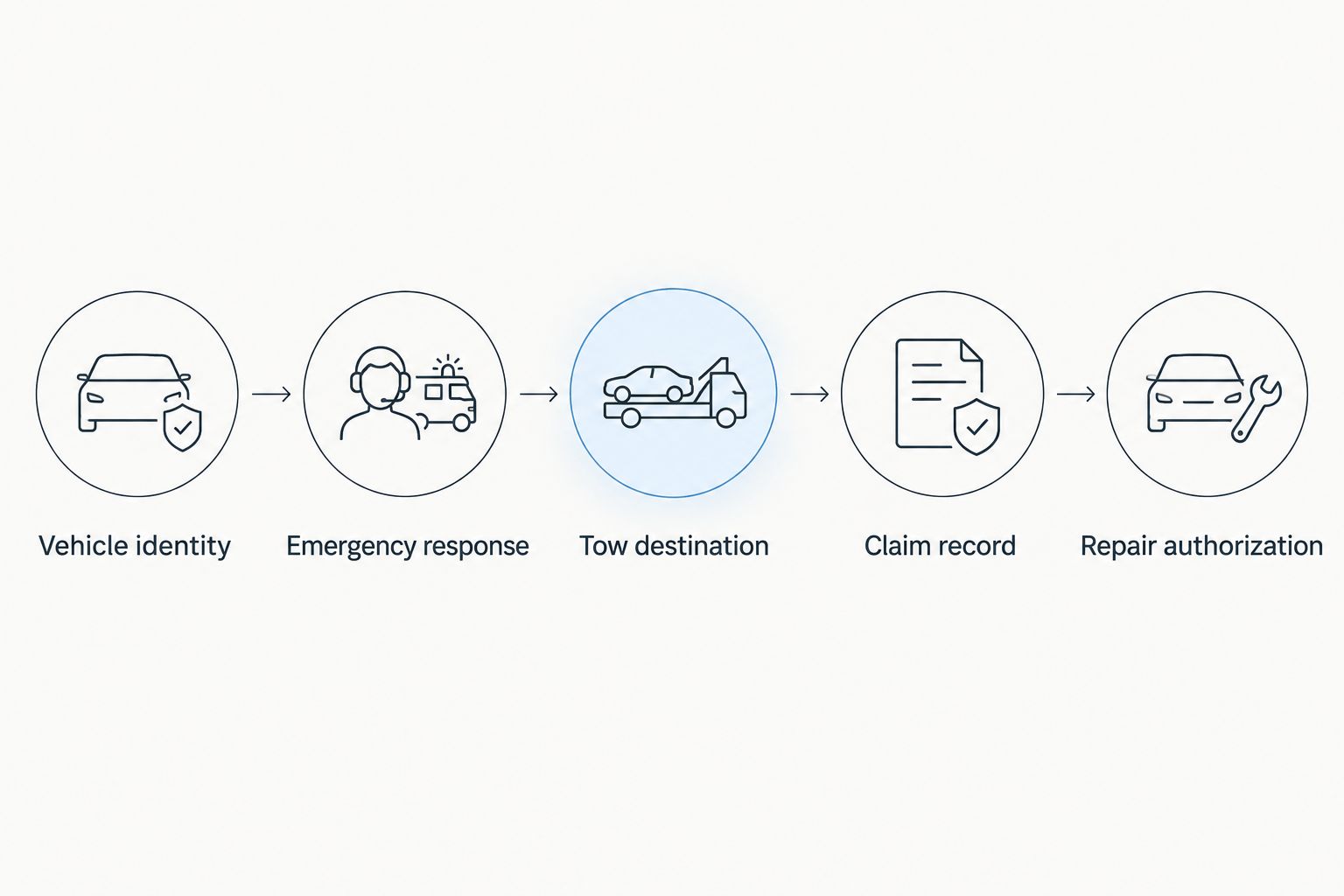
The handoff follows a sequence: Vehicle identity, Emergency response, Tow destination, Claim record, and Repair authorization. Keep these labels in your notes so each contact can see what is complete and what still needs confirmation.
Insurance claim and inspection record
Connect the claim to the vehicle
- Contact your insurer through a verified channel. Report the incident and obtain the claim number and assigned contact when available. Describe what you know; distinguish observations from conclusions about fault or hidden damage.
- Create one shared summary. Include the VIN, incident date, claim number, vehicle location, receiving center, and your callback details. Send only information each recipient needs, using the recipient’s approved communication method.
- Share existing evidence safely. Provide relevant photographs, incident documents, and prior estimate correspondence. Never return to an unsafe roadway or approach a damaged vehicle merely to complete the file.
- Clarify the inspection scope. Ask the shop what inspection or disassembly permission it needs and ask the insurer what documentation it requires. Read each authorization before agreeing.
- Identify who handles estimate changes. Establish the shop contact responsible for additional findings and the insurer contact reviewing them. Ask how you will receive and approve changes affecting your responsibilities.
Expected result: The insurer and repair center can identify the same vehicle and claim without treating the initial report as a complete repair plan.
Your 2026 claim file should distinguish reported damage, inspection findings, and authorized work. These are recordkeeping labels for your own checklist, not promises about fields in a particular insurer’s portal.
MB Collision Group provides insurance-claim assistance. Confirm the receiving center’s role in your specific claim rather than assuming the shop can decide coverage or authorize work on your behalf.
Repair authorization and completion record
Document the decisions
- Read the proposed repair scope. Ask which damage the inspection identified, what remains under review, and whether further disassembly is needed to establish the repair plan.
- Ask about vehicle-specific procedures. Request an explanation of applicable manufacturer repair instructions, diagnostic work, and calibration requirements. Not every collision requires the same operations; the vehicle and affected systems determine the plan.
- Keep approvals distinct. Separate your repair authorization from insurer coverage decisions and vehicle-release instructions. Ask the relevant party to clarify anything the documents leave ambiguous.
- Set the update method. Agree on who contacts you, which communication channel to use, and which decisions require your response. Request written summaries for changes to the agreed scope.
- Review the completion documents. Before collecting the vehicle, ask the repair center to explain the completed work, unresolved concerns, and applicable scan or calibration documentation. Keep copies with your claim records.
Expected result: You have a documented repair decision, a clear route for changes, and a completion record tied to your vehicle.
Do not equate an insurance estimate with a completed repair plan. An estimate records a proposed scope; ask how later inspection findings will be documented and reviewed before additional work proceeds.
When the crash alert never reaches you
The second workflow starts when you learn about the collision directly rather than through a connected-service notification. You do not need a telematics event to begin arranging inspection, transport, and an insurance claim.
| Workflow | Best for | Advantage | Limitation |
|---|---|---|---|
| Confirmed crash-alert handoff | Drivers who have already connected with emergency assistance | Provides an existing emergency contact event to document | Does not establish repair booking, coverage, or authorization |
| Direct owner-initiated handoff | Drivers without a confirmed alert or connected-service response | Lets you coordinate the claim and receiving shop directly | Requires you or an authorized contact to confirm each handoff |
For the direct route, begin with safety and vehicle identity, then continue through the same destination and claim checks. Tell the repair center that no connected-service notification has been confirmed so nobody waits for information that you have not received.
For a 2026 vehicle using a differently named connected service, keep the same repair workflow and verify that service’s actual instructions separately. The repair handoff depends on confirmed communication, not the label on the emergency feature.
Troubleshooting the handoff
The account works, but emergency-feature status is unclear
A successful login does not prove that a specific vehicle feature operates. Check current vehicle-specific documentation or contact Mercedes-Benz support; do not test emergency functions by creating a false emergency. Arrange necessary assistance directly rather than waiting for account troubleshooting.
The tow operator and shop have different destinations
Pause a nonemergency transfer until the intended receiving center acknowledges the destination. Give the operator the confirmed location and contact, then obtain arrival confirmation. Follow responders’ directions if the vehicle first needs removal from a hazardous scene.
The insurer cannot match the shop’s paperwork
Compare the VIN and claim number on both records. Correct the mismatch with the assigned contacts and resend the relevant documents through their accepted channels. Avoid creating a second claim simply to resolve a document-routing problem.
The shop describes certification without naming Mercedes-Benz
Ask for manufacturer-specific, location-specific confirmation before approving the transfer or repair. MB Collision Group’s factory-certified-center description does not establish Mercedes-Benz certification for every receiving location. Keep that verification explicit.
Additional damage changes the initial estimate
Ask the repair center to document the findings and explain the revised scope. Confirm what needs insurer review and what requires your authorization. An earlier estimate should not substitute for a clear explanation of newly identified work.
Customize your workflow
Make a reusable accident-handoff note with 3 records: vehicle and contact details, transport and receiving-center details, and claim and authorization details. Keep sensitive documents out of shared messages that do not need them.
Use 2 confirmations before a planned transfer: the receiving center has accepted the destination, and the transport provider has the correct instructions. These are checklist requirements, not a promise about transport timing.
If you drive a leased or company vehicle, check the owner’s reporting and authorization requirements before approving work. If glass damage is involved, ask whether the affected vehicle systems require additional procedures; do not assume glass replacement and collision repair have identical scopes.
Plan your repair handoff
Identify a receiving center and confirm certification, intake instructions, and claim-assistance responsibilities.
FAQ
Does Mercedes-Benz mbrace automatically book collision repairs?
Do not treat a crash notification as a repair booking. Confirm the receiving repair center, transport arrangements, and repair authorization separately for your vehicle and service.
Can I use this repair workflow if my mbrace service is inactive?
Yes, you can arrange the repair handoff directly without a confirmed connected-service alert. Start with safety, then contact your insurer, transport provider, and chosen repair center.
Is MB Collision Group Mercedes-Benz certified at every location?
Verify Mercedes-Benz certification for the specific receiving location and vehicle. MB Collision Group operates factory-certified centers, but that description does not establish manufacturer-specific certification at every location.
What information should I send the collision center after a crash?
Send the vehicle identity, your contact details, current vehicle location, and claim information when assigned. Include relevant incident documents and photographs through the center’s accepted communication method.
Should I drive my Mercedes-Benz to the body shop after an accident?
Do not use a crash notification or the ability to start the vehicle as proof that it is safe to drive. Follow emergency responders’ directions and obtain qualified guidance when damage or warnings raise safety concerns.
Does an insurance estimate authorize the shop to start repairs?
Treat insurance review and your repair authorization as separate decisions. Read the shop’s documents and confirm the approved scope before authorizing work.
What should I check before collecting my repaired vehicle?
Review the completed work and ask about applicable diagnostic and calibration documentation. Have the repair center explain unresolved concerns and keep the completion records with your claim file.
One last thing
Before a planned tow, ask one question: “Who will confirm that my vehicle has physically arrived?” A destination on a dispatch record is not the same as acknowledged possession. Add the receiving person’s name and confirmation to your 2026 claim notes.