
Insurance approval of a collision repair estimate has no universal turnaround time; receiving an estimate does not automatically mean the insurer has everything needed to decide the claim. California’s claims-handling deadlines provide checkpoints in 2026, but they are not a guaranteed repair-estimate approval schedule. Coverage review, damage inspection, and supplemental repair requests are separate issues that can keep repairs from moving ahead.
- How long does insurance take to approve a repair estimate? California deadlines are checkpoints, not guaranteed approval dates.
- California generally requires a claim decision within 40 calendar days after proof of claim, subject to permitted extensions.
- Estimate approval, repair authorization, and vehicle completion are separate milestones.
- MB Collision Group serves Southern California drivers needing factory-certified collision repair and insurance-claim assistance.
Why this matters
Ask what is blocking the decision, not just when the estimate will be approved. An adjuster waiting for photographs needs a different response from an adjuster investigating coverage. A repair shop waiting for a supplemental estimate decision faces another issue entirely.
Start by confirming that the insurer and repair facility have each other’s contact information. This guide to connecting an insurance adjuster to your repair estimate explains that handoff.
Keep the claim number, estimate version, submission date, and adjuster’s name together. These details let you ask about a specific document rather than receive a general claim-status update.
How long does insurance take to approve a repair estimate?
There is no reliable universal average to apply to your claim. For California claims in 2026, the useful reference points come from the California Fair Claims Settlement Practices Regulations, particularly California Code of Regulations, title 10, sections 2695.5 and 2695.7.
| California checkpoint | General timing rule | What it does not mean |
|---|---|---|
| Acknowledging notice of a claim | Within 15 calendar days, subject to regulatory exceptions | The repair estimate is approved |
| Responding to claimant communications that reasonably require a response | Within 15 calendar days | The response must approve repairs |
| Accepting or denying a claim after proof of claim | Within 40 calendar days, unless additional time is permitted under the regulations | Every estimate must be approved within 40 days of submission |
| Continuing a qualifying investigation | Written updates generally every 30 calendar days after the extension notice | The insurer has an unlimited, unexplained extension |
These are claim-handling rules, not a shop’s promised turnaround. The 40-calendar-day period concerns acceptance or denial after proof of claim. It does not simply start whenever someone uploads a repair estimate.
Proof of claim concerns evidence supporting the claim and the amount of loss. Ask the adjuster what information establishes that milestone in your file and what remains outstanding.
An insurer also must conduct a reasonable investigation. A calendar deadline does not remove legitimate questions about coverage, responsibility, or whether particular damage resulted from the reported accident.
Initial estimate: confirm what the insurer received
An initial estimate describes the damage identified during the first assessment. It can establish a starting repair scope without resolving every operation the vehicle will need.
A submission receipt is not approval. Ask whether the estimate reached the assigned adjuster, whether the photographs are usable, and whether an inspection is still required. Get the answer in writing when possible.
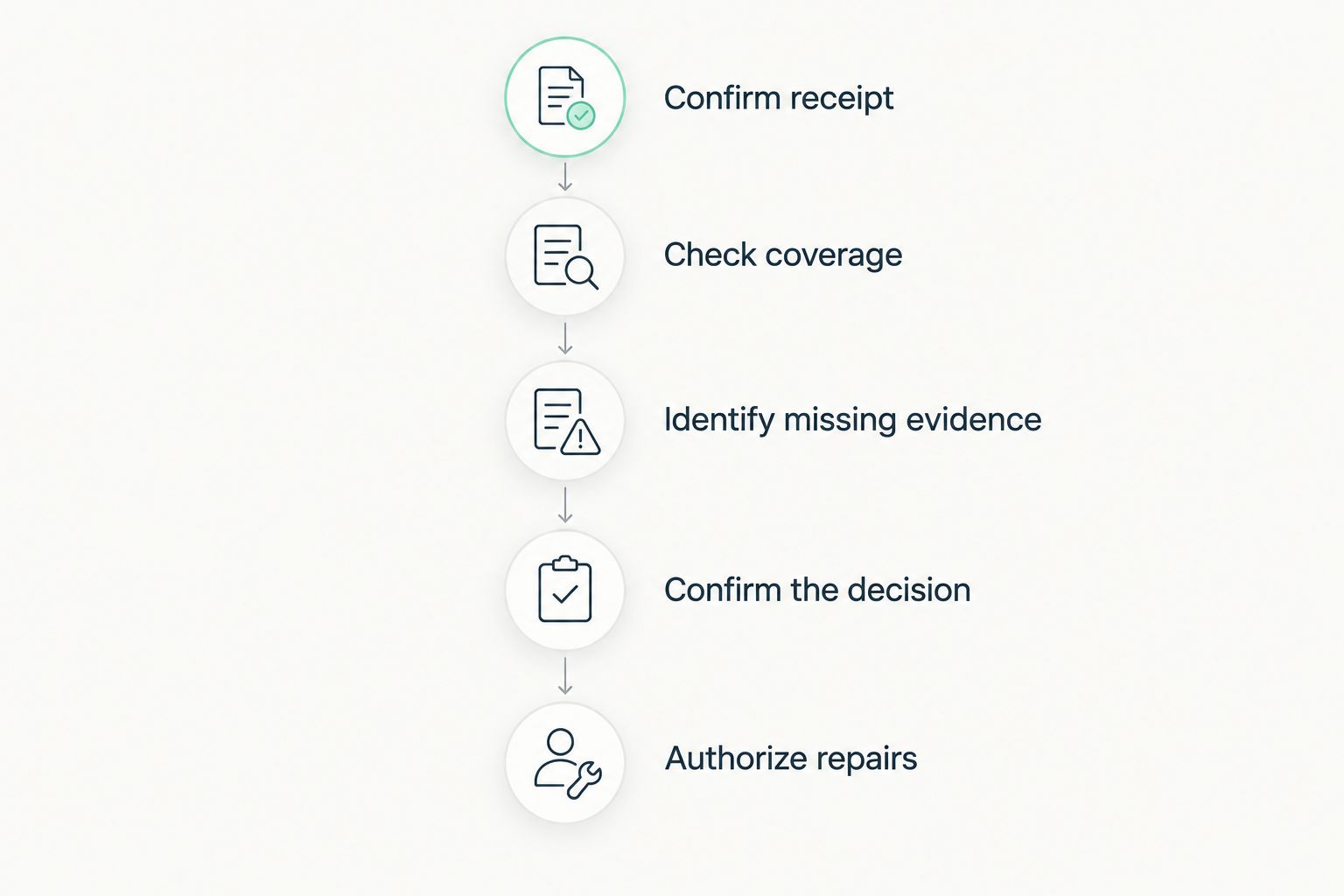
Use this sequence to identify the next action:
- Confirm receipt. Identify the estimate’s submission date and version.
- Check coverage. Ask whether any policy or accident-investigation issue remains open.
- Identify missing evidence. Request a specific list of photographs, documents, or inspection needs.
- Confirm the decision. Ask which repair operations the insurer accepts and which remain disputed.
- Authorize repairs. Review the shop’s authorization separately from the insurer’s payment position.
The sequence separates document delivery from an actual decision. If the estimate is sitting in the wrong queue, asking for a completion date will not solve the handoff problem.
Supplemental estimate: identify the newly documented damage
A supplemental estimate requests changes to the original repair scope. It often follows disassembly that exposes damage not visible during the initial inspection.
Approval of the first estimate does not automatically approve a supplement. Ask the shop which additional operations it submitted, when it submitted them, and what documentation supports them. Then ask the adjuster whether another inspection or explanation is needed.
A supplement is not, by itself, evidence that the original estimate was careless. Exterior photographs cannot show every concealed component or attachment point. The useful question is whether the newly requested work has supporting evidence.
Also ask whether the disputed work prevents the next repair operation. A supplement awaiting review and a vehicle completely stopped in production are not interchangeable status updates.
Why insurance estimate approval time varies
The same question about approval time can describe several different bottlenecks. For your 2026 claim, identify which of these issues actually applies before choosing the next step:
- Coverage review. The insurer must determine whether the policy covers the reported loss. An accepted repair scope does not resolve an outstanding coverage question.
- Responsibility for the accident. A claim against another driver’s insurer can involve an investigation of liability. That differs from reviewing damage under your own collision coverage.
- Inspection requirements. Photographs can leave damage unclear. Ask whether the adjuster needs an in-person inspection or additional images.
- Supporting documentation. An estimate without the requested evidence leaves an unresolved review task. Request the missing items by name.
- Supplemental damage. Newly exposed damage changes the requested repair scope. Confirm which estimate version is under review.
- Repair-scope disagreements. The insurer and shop can disagree about a repair operation or supporting documentation. Identify the disputed line item rather than treating the whole estimate as one unanswered request.
Do not assume that an insurer’s silence means approval. Equally, do not assume every delay is a denial. Request the actual position and the reason behind it.
Photo estimate or in-person inspection: what changes?
A photo estimate and an in-person inspection are assessment methods, not competing insurance benefits. Neither method guarantees immediate approval or a final repair scope.
| Assessment method | Best for | Advantage | Limitation |
|---|---|---|---|
| Photo estimate | Documenting visible exterior damage | Lets an estimator review submitted images | Cannot expose concealed damage |
| In-person inspection | Examining damage directly | Allows closer assessment of the vehicle | Still cannot reveal everything without disassembly |
| Inspection after disassembly | Documenting concealed damage | Supports requests for newly identified repair operations | Can require a supplemental estimate review |
Use the assessment method that documents the damage, not the one that sounds fastest. If the shop identifies damage outside the photographs, ask how that evidence will reach the adjuster.
Do not dismantle damaged components yourself to improve an insurance submission. Let the repair facility explain the inspection and authorization process before work begins.
What should you ask when approval is delayed?
Ask for a written status that names the pending task, its owner, and the next update date. A reply that says only that the claim is under review does not explain what you need to do.
Use these questions during your next call:
- Has the assigned adjuster received the current estimate and supporting photographs?
- Is coverage accepted, denied, or still being investigated?
- Is the insurer reviewing the initial estimate or a supplement?
- Which specific information is missing, and who must provide it?
- Is another vehicle inspection required?
- Which repair operations remain disputed?
- When should you expect the next written response?
Afterward, send a short message recording the answers. Include the claim number and estimate version so the conversation stays attached to the correct request.
For California claims in 2026, the 15-calendar-day response rule is a useful checkpoint for communications that reasonably require a response. It does not turn your message into an automatic approval request or guarantee the answer you want.
When should you escalate an unanswered estimate?
Escalate when you cannot obtain a clear explanation of the pending issue or when a stated follow-up date passes without an update. Start with the assigned adjuster, then request the claims supervisor’s review.
Give the supervisor a concise timeline: claim notice, estimate submission, requested documents, your responses, and unanswered communications. Attach the relevant messages rather than relying on a verbal account.
California’s extension rules require written explanations when additional time is needed under the applicable provisions. Continuing notices generally follow at 30-calendar-day intervals. An extension notice explains an ongoing investigation; it is not approval of the estimate.
If the insurer’s handling remains unresolved, the California Department of Insurance accepts consumer complaints. Keep the complaint focused on documented conduct and communications; a complaint does not itself authorize repairs or establish coverage.
Does estimate approval mean repairs can start?
Estimate approval does not, by itself, establish that the vehicle is ready to enter production. Your authorization, the agreed repair scope, parts coordination, and the shop’s schedule remain separate matters.
Ask the facility to distinguish insurer review from repair scheduling. That distinction prevents you from pursuing the adjuster for a delay that is actually elsewhere in the repair process.
MB Collision Group is best for Southern California drivers seeking factory-certified collision repair and insurance-claim assistance. Its stated services match that need, but choosing a facility does not remove the insurer’s coverage review or guarantee an approval date.
You can discuss the repair handoff with MB Collision Group. Ask which estimate is pending and which next action belongs to you, the shop, or the insurer.
Does rental coverage continue while approval is pending?
Rental coverage depends on the applicable policy or claim arrangement; a pending estimate does not establish unlimited transportation coverage. Confirm the benefit terms and any authorized rental end date directly with the responsible insurer.
Separate the rental discussion from the repair estimate discussion. Ask whether any extension requires another authorization and what documentation the insurer wants from the repair facility.
For a 2026 claim, keep rental confirmations with the rest of the claim correspondence. An approval conversation about repairs is not a substitute for written clarification about transportation.
FAQ
How long does insurance take to approve a repair estimate in California?
There is no universal repair-estimate approval period. California generally requires acceptance or denial within 40 calendar days after proof of claim, subject to permitted extensions; that is not a guaranteed estimate-approval deadline.
Does my insurer have to respond within 15 days?
California generally requires a response within 15 calendar days to claimant communications that reasonably suggest a response is expected. A response is not necessarily approval of the repair estimate.
Does the 40-day deadline start when my body shop sends the estimate?
The 40-calendar-day California claim-decision rule runs from receipt of proof of claim, not automatically from an estimate upload. Ask the adjuster which information establishes proof of claim in your file.
Why does insurance need another estimate after approving the first one?
A supplemental estimate documents additional or changed repair work, including concealed damage found during disassembly. Approval of the original estimate does not automatically approve that additional scope.
Can my body shop start repairs before insurance approves everything?
Repair authorization and insurance approval are separate. Before authorizing work, ask the shop what remains unapproved and what financial responsibility the authorization places on you.
Can MB Collision Group help with an accident insurance claim?
MB Collision Group provides insurance-claim assistance alongside collision repair services in Southern California. Ask about your specific estimate handoff without assuming an insurer approval deadline.
What should I do if the adjuster stops answering?
Send a written request identifying the claim number, estimate version, pending question, and requested status update. If it remains unanswered, request a claims supervisor’s review and retain the correspondence.
One last thing
The most useful approval question is: which repair operations remain unapproved? A claim can have an accepted initial estimate and a pending supplement at the same time.
Before ending your next call, ask for the current estimate version and the exact unresolved items. That gives you a next move instead of another vague promise to check back.