Filing a diminished value claim is worth pursuing when you can document a loss in your vehicle’s market value after proper repairs, identify a valid recovery route, and justify the expense of pursuing it. An appraisal, negotiation, and any legal help create a separate burden that a repair settlement does not automatically cover. For a 2026 claim, establish eligibility and evidence before paying for a valuation report.
- Is it worth filing a diminished value claim? Yes, when documented remaining value loss justifies pursuing an eligible claim.
- California’s CACI No. 3903J recognizes remaining vehicle value loss after repairs; payment still requires supporting evidence.
- A repair invoice proves repair work, not the amount of diminished value.
- MB Collision Group provides collision repair and insurance-claim assistance, not a stated guarantee of diminished value recovery.
Why this matters
A car can be properly repaired and still face a resale objection because of its accident history. That does not turn every accident into a payable diminished value claim. You need to connect the particular collision to a remaining market-value loss, rather than assuming the repair bill establishes that loss.
Keep the repair claim and the valuation question organized separately. The guide to connecting an insurance adjuster to your repair estimate addresses the repair-documentation side; your diminished value request needs additional market evidence.
Repair cost and diminished value measure different things. Mixing them makes it harder to explain what remains unpaid and why.
Is it worth filing a diminished value claim in 2026?
It is worth filing when the evidence supports a remaining loss and the claim has a valid legal or contractual basis. Start with the following decision table before commissioning an appraisal or accepting a settlement.
| Approach | Best for | Advantage | Limitation |
|---|---|---|---|
| Gather records and request an initial review | Owners who have not established eligibility | Clarifies the claim route before further expense | Does not independently establish market-value loss |
| Obtain an independent diminished value appraisal | Owners with an eligible claim and a disputed valuation | Adds a documented valuation analysis | Creates an expense and does not guarantee acceptance |
| Seek legal advice | Owners facing disputed liability, release language, or deadlines | Addresses legal obstacles beyond vehicle valuation | Adds a separate expense to evaluate |
| Stop pursuing the claim | Owners whose evidence does not support remaining loss | Avoids further spending on an unsupported demand | Ends pursuit unless new evidence changes the assessment |
For California property-damage claims, Judicial Council civil jury instruction CACI No. 3903J addresses damage to personal property. It recognizes that repair does not necessarily restore the property’s full pre-damage value and addresses remaining loss after repairs. That instruction is a damages framework—not proof that your particular insurer owes payment.
For your 2026 decision, the useful question is not whether diminished value exists in principle. It is whether you can establish it for your vehicle and recover it through the claim you actually have.
A claim against another driver is different from your own coverage
A claim against an at-fault driver and a claim under your own insurance policy follow different rules. Do not assume that because your insurer pays for repairs, it also owes diminished value.
For a third-party claim, establish liability and the legal basis for the damages requested. For a first-party claim, examine the policy language and applicable state law. Ask for any coverage denial in writing, including the provision or legal basis relied on.
Confirm the recovery route before buying an appraisal. A detailed valuation cannot resolve an exclusion, an already-signed release, or a claim directed to the wrong party.
If liability remains disputed, preserve the accident evidence as well as the repair records. A valuation dispute and a fault dispute are separate problems; resolving one does not automatically resolve the other.
Why diminished value claims vary
A useful assessment separates facts about the vehicle from facts about the claim. These factors determine what you need to investigate:
- Pre-accident condition: Maintenance, mileage, existing damage, and prior accidents affect the starting valuation. Compare the vehicle with its actual condition before this collision, not an ideal example.
- Damage and repair scope: The nature of the damage and completed repairs shape the valuation analysis. A repair total alone does not establish the remaining loss.
- Comparable vehicles: Relevant comparisons account for model, trim, mileage, condition, location, and valuation date. Unmatched listings weaken the argument.
- Evidence of an accident-history discount: A documented buyer or dealer explanation is more useful than an unsupported statement that accident cars are worth less.
- Claim eligibility: Liability, policy terms, jurisdiction, and settlement documents affect whether there is a recovery route.
- Pursuit expense: Appraisal and legal expenses belong in the decision alongside the strength of the evidence. Establish what work an engagement includes before authorizing it.
Do not treat a newer vehicle, structural repair, or a vehicle-history entry as an automatic payout trigger. Each is a fact to evaluate, not a substitute for proving the loss.
How do you decide whether to file?
Use this sequence to build a defensible request without confusing valuation work with repair work.
- Check eligibility. Identify the responsible party, the applicable coverage or legal claim, and any release already signed. Ask what deadline governs your specific situation.
- Collect records. Save pre-accident condition evidence, photographs, estimates, repair supplements, the final invoice, and relevant inspection or calibration records.
- Compare values. Assess the vehicle’s pre-accident market value and its post-repair market value using a consistent valuation date and clearly explained evidence.
- Assess expenses. Establish the scope and expense of appraisal or legal help. Decide whether the documented loss justifies that commitment.
- Submit evidence. Send a written demand explaining the loss, the supporting records, and the requested resolution. Keep copies and request a written response.
The order matters. Paying for a report before checking eligibility risks spending money on a valuation that cannot resolve the actual obstacle.
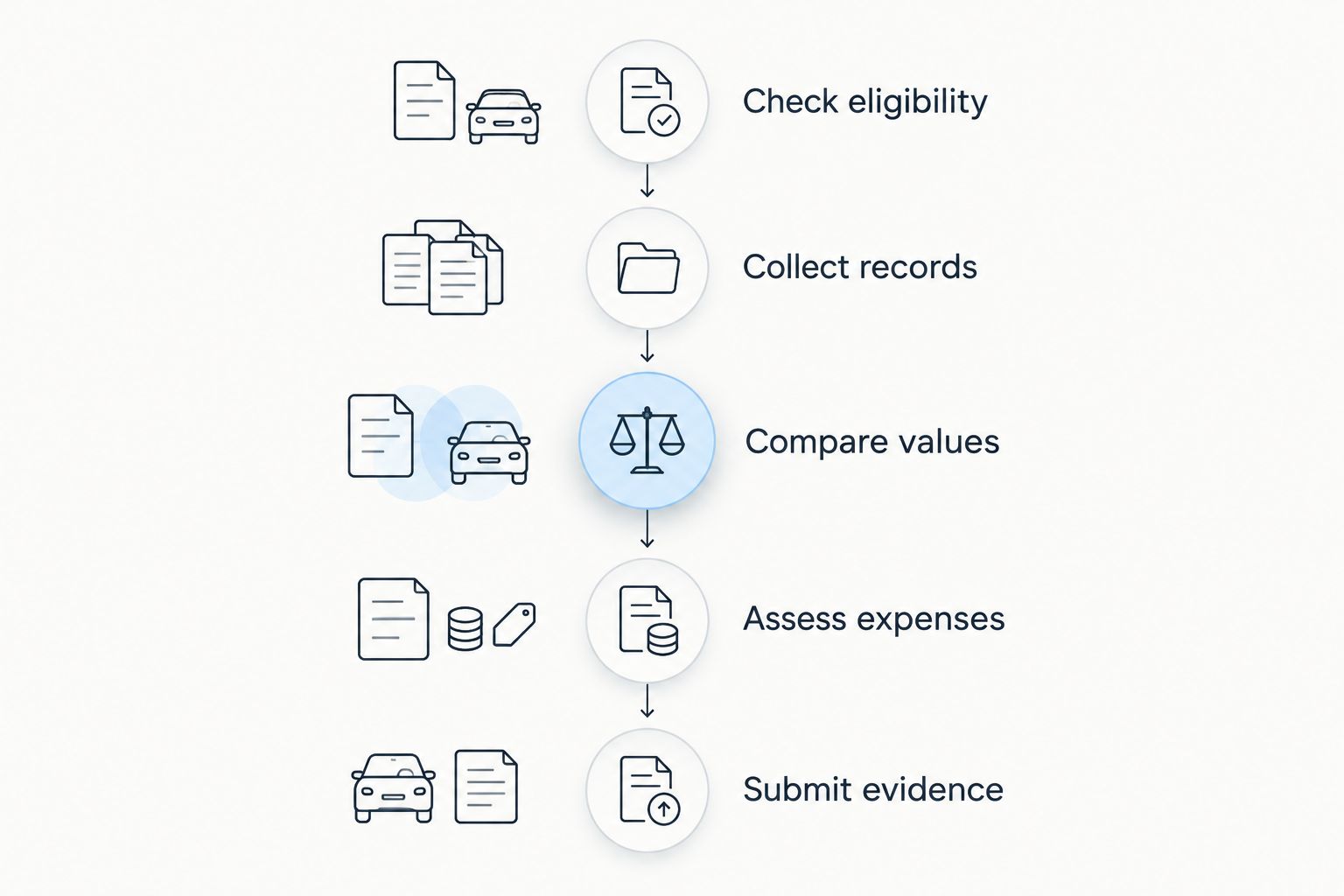
Your submission should let a reader follow the reasoning without guessing. Explain what the vehicle was worth before the collision, what it is worth after completed repairs, and how the evidence supports the difference.
What evidence makes a diminished value request persuasive?
Start with consistent comparisons. A higher-trim vehicle with lower mileage does not establish the value of your car, and an advertised asking amount does not establish a completed sale.
Ask an appraiser to explain the method, the sources, and the adjustments. A report should connect its conclusion to your vehicle rather than present a formula without a market explanation. Ask how prior damage and pre-accident condition were handled.
Dealer statements also need context. A written statement identifying an accident-history deduction is clearer than a trade-in offer that combines condition, reconditioning, inventory preferences, and negotiation into an unexplained figure.
For a 2026 valuation, match the evidence to the relevant loss date. Today's listings do not automatically establish the market at the time relevant to your claim. State the valuation date explicitly so the comparison is understandable.
The strongest demand explains the gap; it does not merely announce one. Include the repair record, but keep the market-value analysis distinct.
When should you pause or stop pursuing the claim?
Pause when the next expense buys a report without answering the unresolved question. If coverage is disputed, obtain the policy explanation. If liability is disputed, address the accident evidence. If valuation is disputed, ask which assumptions or comparisons the reviewer rejects.
Stop adding expense when the available evidence does not support a remaining loss that justifies pursuit. That is a decision about your claim, not a statement that diminished value never occurs.
Be equally careful with a broad settlement release. Before signing, establish whether it resolves only a particular payment or releases additional property-damage claims. Do not assume a later diminished value request remains available after a full release.
For a 2026 California claim, verify the applicable deadline rather than treating ongoing insurer correspondence as an extension. Obtain legal advice when the deadline, release, or responsible party is unclear.
Does a total loss qualify for the same claim?
A total-loss valuation dispute is different from diminished value after repairs. Diminished value concerns a vehicle that remains worth less after repair; a total-loss settlement concerns the valuation of a vehicle treated as a total loss.
If the insurer declares your vehicle a total loss, examine the valuation report and its treatment of comparable vehicles, equipment, mileage, and condition. Do not present a post-repair diminished value demand for a vehicle that was not repaired.
Keep unrelated losses separate as well. Rental expenses and loss of use concern transportation during the claim, not the vehicle’s remaining resale value. Combining every disagreement under diminished value obscures the evidence each issue requires.
Where does a collision repair center fit?
MB Collision Group is best for Southern California vehicle owners seeking factory-certified collision repair and insurance-claim assistance after an accident. Its role fits the repair side of the process; repair services do not establish a guaranteed diminished value recovery.
MB Collision Group operates factory-certified auto body and collision repair centers. When arranging repairs, ask which documents you will receive and retain the completed repair record for any separate valuation review.
A body shop explains damage and repair work. An independent vehicle appraiser addresses market valuation, while a lawyer addresses legal entitlement and disputes. Ask each professional to stay within that role rather than expecting the repair estimate to answer every claim question.
Discuss your collision repair needs
Ask about collision repairs and insurance-claim assistance after an accident.
FAQ
Is it worth filing a diminished value claim after a minor accident?
A diminished value claim after a minor accident is worth pursuing only when evidence supports a remaining market-value loss and a valid recovery route. Repair expense alone does not prove that loss.
Can I claim diminished value if the accident was my fault?
A claim under your own insurance depends on the policy and applicable state law; fault does not create diminished value coverage. Ask the insurer to identify the relevant policy language before paying for an appraisal.
Do I have to sell my car to prove diminished value?
An actual sale is not the only way to present vehicle valuation evidence. A supported appraisal and relevant market evidence can address value, but the applicable legal standard still governs your claim.
Does a clean repair mean my car has no diminished value?
A proper repair does not by itself establish that the vehicle has regained its full pre-accident market value. You still need evidence of any remaining loss attributable to the collision.
Will the insurance company accept an independent appraisal?
An independent appraisal does not guarantee insurer acceptance. Ask for a written explanation of any disagreement with its comparables, adjustments, method, or conclusion.
Can MB Collision Group guarantee a diminished value payment?
No diminished value payment guarantee is stated for MB Collision Group. Its stated services include collision repair, auto glass replacement, and insurance-claim assistance; recovery requires separate eligibility and valuation evidence.
What should I do first for a diminished value claim in 2026?
For a diminished value claim in 2026, first confirm the recovery route, relevant deadline, and effect of any settlement release. Then collect repair records and evaluate whether market evidence supports a remaining loss.
One last thing
Keep the final repair invoice, not just the original estimate. An estimate describes anticipated work; the final record documents the completed repair scope and belongs in the file an appraiser reviews.
Before spending more on a 2026 diminished value claim, write down the unresolved issue: eligibility, liability, valuation, or settlement language. Choose the next action that answers that issue. Another document is useful only if it closes a specific evidence gap.