A diminished value claim pays the supported loss in your vehicle’s market value after an accident and repairs, subject to the applicable law, liability, and available insurance coverage—not a fixed average or a percentage of the repair bill. In 2026, the amount you request is separate from repair expenses, and appraisal expenses or other claim-preparation costs are not automatically reimbursed.
- How much does a diminished value claim pay out? The answer depends on documented market loss, liability, and coverage.
- A repair invoice documents work performed; it does not establish the vehicle’s remaining loss in market value.
- Compare the vehicle’s pre-accident value with its repaired value using consistent mileage, condition, equipment, and market assumptions.
- MB Collision Group serves Southern California drivers needing collision repair and insurance-claim assistance, not a guaranteed settlement.
Why this matters
Getting your vehicle repaired and recovering its remaining loss in value are different tasks. A completed repair does not erase an accident history, but an accident history alone does not establish the amount an insurer owes.
Your claim needs evidence of a remaining market loss, not just evidence that a collision happened. Keep the valuation question separate from repair authorization so an argument about resale value does not distract you from necessary repairs. The car accident to certified repair claims workflow explains how the repair and insurance steps connect.
How much does a diminished value claim pay out in 2026?
There is no universal payout schedule. The starting point is the difference between your vehicle’s supported market value immediately before the accident and its supported market value after proper repairs, measured on a consistent basis.
Supported pre-accident market value − supported repaired market value = claimed remaining loss.
That calculation describes the loss you are trying to prove. It does not determine whether your policy covers the claim, establish another driver’s responsibility, or guarantee payment of your demand.
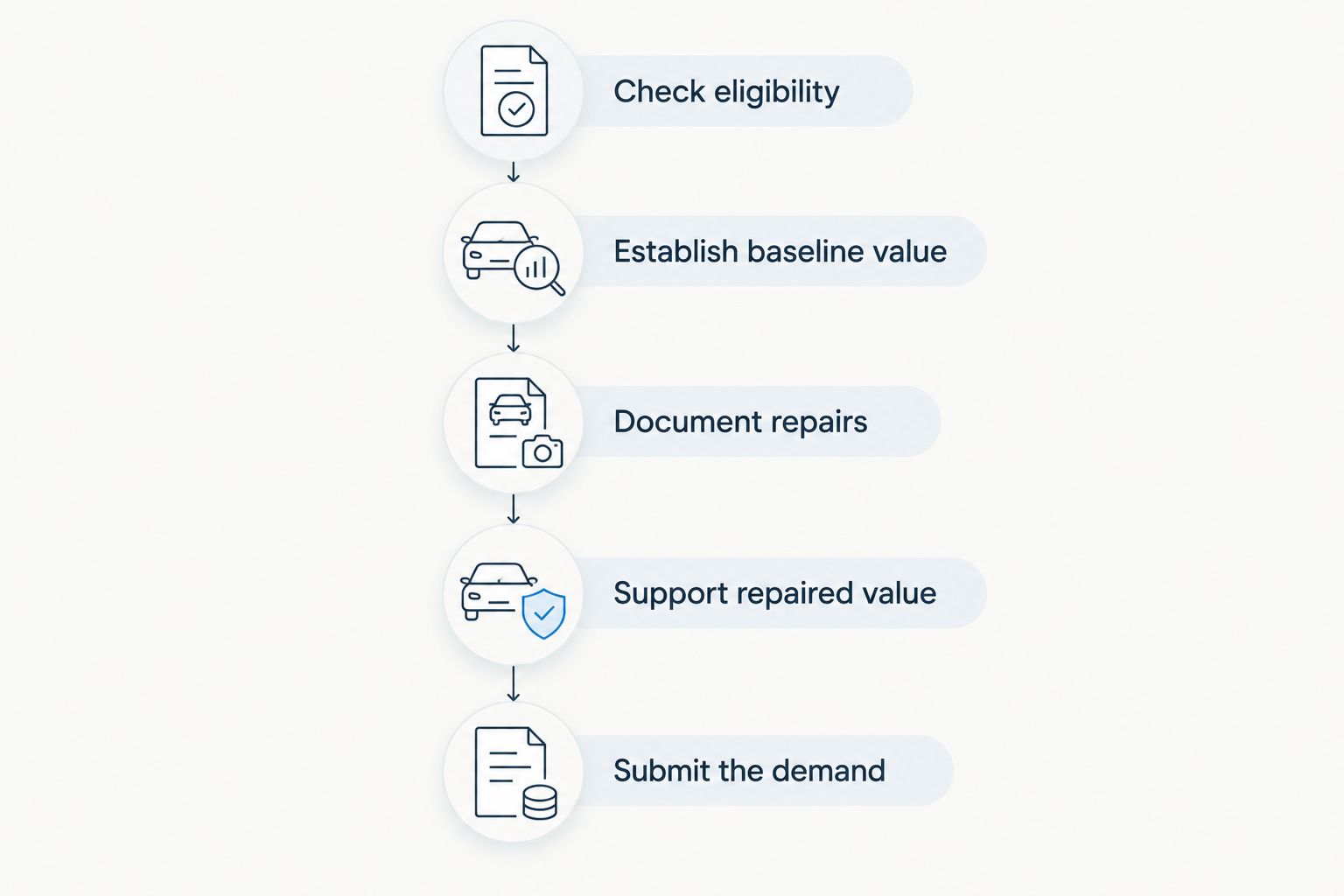
Build the amount in this order:
- Check eligibility. Identify whose insurer you are asking to pay and which state’s rules apply.
- Establish baseline value. Document your vehicle’s mileage, trim, equipment, condition, and prior accident history.
- Document repairs. Collect photographs, the final invoice, supplements, and relevant inspection records.
- Support repaired value. Use market evidence or a reasoned appraisal that addresses the accident history.
- Submit the demand. Explain the difference, attach supporting records, and request a written response.
The useful question is not what another owner received. It is whether your evidence supports the difference you are requesting for your particular vehicle.
Which records actually support the amount?
Different records answer different questions. A repair invoice establishes what work was billed; a valuation report must explain how the accident affects the vehicle’s market value after that work.
| Evidence | Best for | Strength | Limitation |
|---|---|---|---|
| Final repair invoice | Establishing repair scope | Identifies parts, labor, and documented operations | Does not measure remaining market loss |
| Vehicle-specific appraisal | Explaining the claimed value difference | Connects vehicle details and damage history to a valuation opinion | Depends on the appraiser’s evidence and reasoning |
| Comparable market listings | Checking baseline market assumptions | Shows asking prices for similar vehicles | Asking prices are not completed sale prices |
| Written purchase offers | Showing an actual buyer’s position | Documents what a buyer offers for the vehicle | Includes buyer-specific margins and other adjustments |
Use these records together rather than treating one document as conclusive. An appraisal supported by relevant comparables is more useful than a report that simply applies a percentage without explaining the market evidence.
Save the underlying material as well as the final report. If a comparable listing disappears or an insurer questions an adjustment, a saved copy lets you explain the source rather than reconstructing it later. Record when each listing or offer was obtained.
Why diminished value payouts vary
For a 2026 claim, the vehicle and the evidence matter more than a generic online estimate. These factors affect either the size of the claimed loss or your ability to recover it:
- Pre-accident value. The starting valuation must reflect the actual vehicle, not the most expensive similar listing.
- Damage severity. Cosmetic damage and structural damage require different explanations of their effect on buyer demand.
- Repair condition. Unresolved defects raise repair-quality questions that should not be confused with accident-history loss.
- Mileage and prior history. Existing wear and earlier collisions belong in the baseline, not in the amount attributed to this accident.
- Market evidence. Closely matched vehicles and reasoned adjustments make the valuation easier to assess.
- Liability and coverage. A documented loss does not remove disputes over fault, exclusions, policy limits, or responsibility for payment.
Avoid double counting. If your pre-accident valuation already reflects an earlier collision, your current demand must isolate the additional loss attributable to the new accident.
The same discipline applies to condition. You cannot compare a worn vehicle before the collision with an unusually clean market example and attribute the entire difference to accident history.
Does a California diminished value claim work differently?
California distinguishes between a claim under your own insurance contract and a property-damage claim against a responsible third party. Do not assume that coverage for collision repairs also includes payment for diminished value. Read the applicable policy and ask the insurer to identify its coverage position in writing.
California’s Judicial Council civil jury instruction CACI No. 3903J addresses damage to personal property, including remaining loss in value after repairs. It also addresses limits on the combined recovery for repairs and remaining diminished value. That damages framework does not override exclusions in your own policy or decide the facts of your claim.
For a California claim in 2026, establish these points before debating the amount:
- Which driver or party is alleged to be responsible?
- Are you presenting a third-party liability claim or seeking benefits under your own policy?
- Does the insurer dispute responsibility, coverage, valuation, or more than one issue?
- Has any release already been signed?
Get legal advice on disputed eligibility, deadlines, or release language. A repair center can explain repair records; it does not replace legal advice about recoverable damages.
Is a repair bill enough to prove diminished value?
A repair bill is not enough to establish diminished value because repair expense and remaining market loss measure different things. Expensive repairs do not automatically produce a matching resale loss, and a modest repair bill does not establish that the loss is negligible.
Read the invoice for what it actually proves: which panels or components were repaired or replaced, what operations were documented, and whether additional damage changed the repair scope. Then connect those facts to your valuation evidence.
Ask for the final invoice rather than relying only on the preliminary estimate. An early estimate can differ from the completed repair record, particularly when inspection reveals damage that was not initially visible.
Keep unresolved repair concerns on a separate list. A fitment problem, warning light, or paint concern calls for inspection; it should not be treated as an unavoidable consequence of accident history before the repair issue is assessed.
Is an independent appraisal worth getting?
An independent appraisal is useful when it explains a disputed value difference with vehicle-specific evidence. It is less useful when the report offers a conclusion without showing how the appraiser reached it.
Before commissioning a report, ask what the assignment includes:
- Identification of the vehicle’s actual trim, mileage, equipment, and prior condition.
- Review of the damage photographs and completed repair documentation.
- An explanation of the pre-accident and repaired valuation methods.
- Relevant market evidence and reasons for any adjustments.
- A distinction between accident-history loss and unresolved repair defects.
Do not treat an appraiser’s demand figure as a promised settlement. The insurer can challenge the method, the comparables, or the assumptions, and the report does not resolve liability or coverage.
Confirm the appraisal terms before proceeding. Ask separately whether the insurer accepts responsibility for that expense; reimbursement should not be assumed merely because the appraisal supports your claim.
How do you evaluate an insurer’s offer?
Start with the insurer’s explanation, not just its final figure. Ask which pre-accident value it used, how it assessed the repaired vehicle, and what facts account for the difference between its valuation and yours.
A useful written response addresses the disputed assumptions. If the insurer used the wrong trim or mileage, identify the error and attach the relevant vehicle record. If the disagreement concerns accident history, ask how that history was reflected in its market evidence.
Use a short comparison list:
- Vehicle identity: Do both valuations describe the same configuration?
- Baseline condition: Do both reflect the vehicle’s actual prior condition?
- Repair scope: Does the insurer have the completed repair documents?
- Market basis: Are the comparable vehicles relevant to the valuation?
- Payment scope: What does the proposed payment settle?
Avoid responding only with a higher demand. A specific correction gives the insurer something concrete to reassess and creates a clearer record if the dispute continues.
Before accepting, read any release. Confirm whether it settles only the diminished value issue or also releases other property-damage claims you have not resolved.
Where collision repair support fits
MB Collision Group is a fit for Southern California drivers who need collision repair and insurance-claim assistance. Its factory-certified collision repair centers address the repair side of the accident process; a diminished value payment remains a separate claim question.
The practical benefit of repair support is a documented account of the work performed. The limitation is equally important: factory certification does not establish a resale-value loss or compel an insurer to pay your requested amount.
When arranging repairs with MB Collision Group, ask which completed repair documents you should retain for your insurance file. Keep those records alongside photographs, insurer correspondence, and valuation material so the repair history and financial claim remain traceable.
Discuss your collision repair needs
Ask about collision repair and insurance-claim assistance in Southern California.
What should you check before submitting the claim?
Your demand should let someone unfamiliar with the accident follow the reasoning without searching through an unorganized attachment folder. Put the requested loss, the valuation method, and the supporting documents in a clear sequence.
Check the submission for these common weaknesses:
- A baseline valuation that ignores prior damage or unusually high mileage.
- Comparables with different trims or equipment and no explanation of adjustments.
- A preliminary estimate presented as the completed repair record.
- A claimed percentage with no supporting market analysis.
- An appraisal that mixes unfinished repairs with permanent accident-history loss.
- Correspondence that leaves the insurer’s actual reason for denial unclear.
For a 2026 submission, date your demand and preserve proof of delivery. Keep a copy of everything you send, including attachments, rather than relying on access to an insurer’s upload portal.
Record follow-up discussions in writing. A short confirmation of the documents received and the issues still disputed is more useful than an unsupported recollection of a telephone conversation.
FAQ
What is the average diminished value claim payout in 2026?
There is no universal average that determines your diminished value payout in 2026. Your demand needs vehicle-specific evidence of remaining market loss, and recovery depends on liability, applicable law, and coverage.
Does diminished value equal a percentage of my repair bill?
Diminished value does not automatically equal a percentage of your repair bill. Repair expenses document the work, while diminished value concerns the vehicle’s remaining loss in market value after repairs.
Can I claim diminished value through my own insurance?
Eligibility under your own insurance depends on the policy and applicable law. Ask the insurer to identify the relevant coverage terms and explain its position in writing.
Do I need to sell my car before making a diminished value claim?
A completed sale is not inherently necessary to document a claimed market-value loss. A vehicle-specific appraisal and other market evidence can support the valuation, subject to the rules governing your claim.
Does factory-certified repair eliminate diminished value?
Factory-certified repair does not establish that a vehicle has no remaining market loss. Repair quality and the market effect of an accident history are separate questions.
Can MB Collision Group guarantee my diminished value payment?
A repair center cannot guarantee an insurer’s diminished value payment. MB Collision Group provides collision repair and insurance-claim assistance; payment depends on the claim’s evidence, liability, and coverage.
Can I add diminished value to a total-loss settlement?
A total-loss settlement and a post-repair diminished value claim address different situations. Review the valuation and settlement terms rather than adding a post-repair loss to a vehicle that was not repaired.
One last thing
Before arguing about the amount, identify what the insurer is actually disputing. A coverage denial needs a different response from a disagreement about mileage, comparable vehicles, or the effect of repaired damage.
For your 2026 claim file, keep a short written list of unresolved issues and the document that addresses each one. That separates evidence you already have from evidence you still need—and keeps a valuation disagreement from turning into a pile of unrelated repair paperwork.